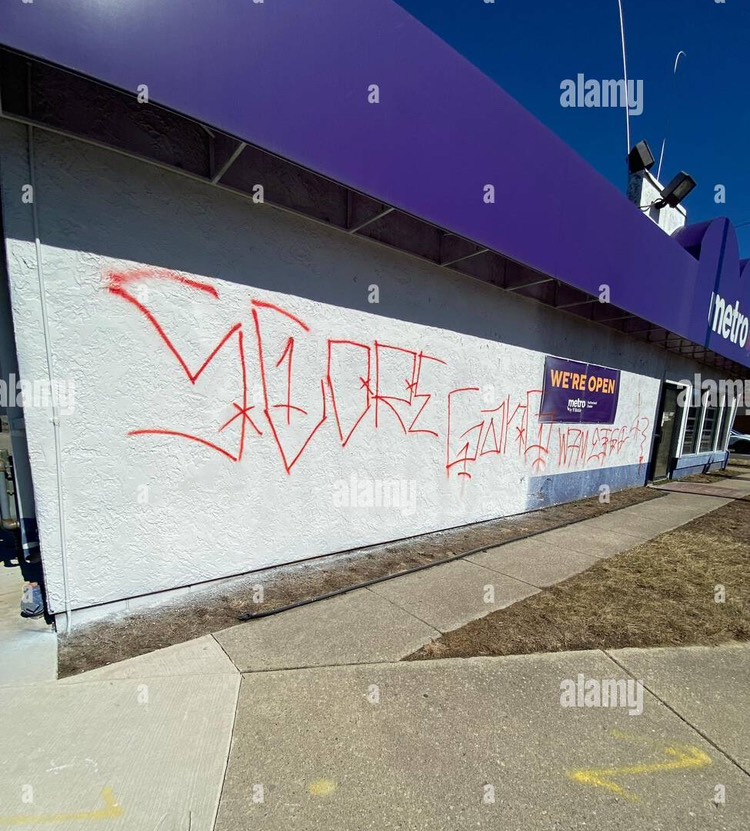
The 5Point Nation Crips (5PN)—also documented under the names ScoreGang (SCRG), 5Points Crips, W7M Hyena Crips (W7M 83GC), Evergreen-Telegraph Gangsters (ETG), W7M 8Tray Gangsta Crips (W7M 8TGC), Frisbee Street Crips (FSC) and 5Pointer Crips—are identified as a large, well-armed, neighborhood-based (hybrid) Crip-affiliated street gang alliance primarily operating in Detroit’s Five Points area on the city’s far northwest side.Rather than functioning as a single, centralized street gang or unified set, the 5Point Nation (5PN) operates as an alliance structure composed of multiple affiliated groups and gangs. Oversight is provided by an internal governing council known as the Nation Board, which is responsible for administering street laws, resolving internal disputes, enforcing organizational doctrine, and maintaining the alliance’s broader interests. The “Nation Board” serves as the top council. Composed of senior “Gangster” (“G”) leaders from various subgroups, with one “G” representing each set or clique, the board votes on alliance-wide decisions and resolves disputes between member groups. According to community accounts, the Nation Board serves the interests of the Nation as a whole rather than any individual set, clique, or member organization, acting as the primary body for governance, coordination, and internal regulation across the alliance. For example, according to numerous community reports and street-level documentation concerning Crips street gangs in Detroit, Zahid “Tiny Joker” Sekou (Matthews) is identified as the designated “G” (Gangster) representing the 24700 Blocc / Frisbee Street Crips (FSC) on the 5Point Nation Crips Nation Board. As the sole founder of the original Bloc Side Soldiers (B.S.S.) crew, which later evolved into the modern W7M ScoreGang (ETGC) Crips street gang, Tiny Joker is described as wielding significant influence across Northwest Detroit. Because Because Frisbee Street (24700 Blocc / FSC) is described as the foundational, most populous, and most active subset within the broader SCRG Crips alliance—with some accounts alleging that more than 100 members claim affiliation with the subgroup—his seat on the “Nation Board” is consequently portrayed as carrying considerable weight. This is also why he was the member who spoke with The Detroit News in August 2025 regarding the group and its internal symbolism, including cliques such as the Hyena Crips / Hyena Gangster Crips, who became associated with “Tag Wars” and the cipher “83GC,” meaning “Hyena Crips Got Control.” The Hyena Crips were reportedly influential enough to produce a youth offshoot known as the “Baby Hyenas Gang” (BHG), described as an active, youth-led Crips street clique operating around the Grandview Street area along West Seven Mile Road in the Five Points neighborhood of Detroit. 5PN is consistently described as a loosely organized network of various Crip-affiliated street gangs and groups, comprising dozens of smaller independent street cliques, tagging crews, and neighborhood blocks.
According to community accounts and available reporting on the 5Point Nation (5PN), the alliance has been described as having an internal structure that extends beyond simple neighborhood affiliation. Sources have alleged the existence of a governing body, sometimes referred to as a “nation board,” responsible for establishing and enforcing organizational rules among participating crews and member groups. Under this reported framework, members are expected to follow guidelines concerning territorial conduct, organizational discipline, and other operational matters, with violations potentially subject to internal accountability. Accounts describing this structure suggest that such rules are intended, among other things, to prevent individual members’ actions from generating unnecessary law-enforcement attention or broader consequences for the alliance as a whole. According to these accounts, the organization began with roughly over a dozen members in 2015 under the name B.S.S. (Bloc Side Soldiers), originally described as a tagger/graffiti crew. It subsequently evolved into a territorial street gang and reportedly expanded to approximately 150 to 200 members by 2025, when it was described in some accounts as one of Detroit’s larger Crips street gangs. Its colors are described as blue, gray, and green, with blue—particularly royal blue and navy blue—being the dominant color. According to local accounts, members of the 5PN Crips could allegedly be initiated in one of three ways. First, a prospective member could be “put-on,” a process reportedly requiring the individual to fight or withstand a beating from another member or members for at least 60 seconds. Alternatively, someone could receive “the race,” in which another member would bring the individual into the gang while requiring the new member to participate in some form of criminal activity within 24-hours, reportedly including vandalism, such as a “tagging mission,” or violence. Finally, an individual could allegedly be “blessed-in” to the gang with the consent of the existing members of a particular clique or crew. Upon initiation, new members were reportedly provided with 5Point Nation literature containing the organization’s alleged by-laws and other information. Membership has been described as hierarchical, with ranks listed in ascending order as “Infant Gangster” (Infant), “Baby Gangster” (BG), “Tiny Gangster” (TG), “Young Gangster” (YG), and “Gangster” (G). According to these accounts, each rank carries particular responsibilities or roles. For example, the role of “shooter,” reportedly associated frequently with the “Tiny Gangster” (TG) rank, allegedly involves protecting other members. Accounts further allege that 5PN Crips members are expected to support fellow members during fights and other criminal activity. Members who allegedly violate organizational rules—such as failing to know the by-laws, failing to attend neighborhood meetings, or refusing orders from higher-ranking members—have reportedly been subject to internal punishment, sometimes described as being “violated,” including beatings, shootings, or stabbings. According to these same accounts, members could advance in rank or demonstrate loyalty to the 5PN Crips by “putting in work.” Reported examples of “putting in work” include placing 5PN Crips and/or ScoreGang (SCRG) graffiti in various locations, committing robberies, home invasions, carjackings, and drive-by shootings, and fighting with rival gangs or groups. The 5PN Crips and its member group, ScoreGang (SCRG), have also been described in reporting and local accounts as being heavily armed. Some accounts allege that firearms are frequently shared among members, stored at other members’ residences, or purchased from one another.
Evidence suggesting the existence of formalized rules emerged in an August 2025 Detroit News feature on the ScoreGang Crips (SCRG) and the broader 5PN alliance and their strategic involvement in localized street-level “tag wars” or gang wars fought over graffiti. The article referenced a photograph of what was described as an alleged page from the group’s handwritten “internal laws,” including a section titled “Guerilla Warfare Doctrine.” According to the report, the document instructed members to “Know your turf like a map” and to “Memorize cuts, exits, rooftops,” emphasizing strategic awareness and territorial familiarity. Zahid “Tiny Joker” Sekou (Matthews) authored the 5Point Nation’s internal tactical guide, widely known on the streets as their “Guerrilla Warfare Doctrine.” This handwritten manual bypassed traditional, rigid gang literature in favor of a highly adaptive urban survival blueprint specifically tailored to the terrain of Northwest Detroit.
The same article on Detroit’s (gang-related) “tag wars” quoted high-ranking (“G”) member, Zahid “Tiny Joker” Sekou, who characterized his group’s graffiti as a form of communication intended to establish territorial boundaries and send messages to rivals without immediate violence. “We’re speaking to each other in symbols and codes so that we don’t have to clash,” he stated. “We’re letting them know: ‘Yo, we got this right here, don’t even think about it.’ It’s psychological.”
Taken together, the reported existence of written rules, references to organizational doctrine, and descriptions of structured communication methods suggest that 5PN functions as more than an informal collection of neighborhood crews. While the full contents of the alleged internal documents, which allegedly contains around 25 sections, remain unavailable to the public, the reporting indicates the presence of an organized framework, disciplinary expectations, and shared operating principles among participating groups, including prominent member sets such as the ScoreGang Crips (SCRG).
Available documentation characterizes the alliance as comprising multiple smaller street gangs and street cliques that self-identify as Crip subsets, many of which are reported to have originated from youth tagger crews and localized street groups that emerged during the mid-2010s.
The alliance is documented as being most active along the Seven Mile corridors and in portions of Redford Township, reflecting the highly localized nature of Detroit’s street-gang landscape. While group identity varies among individual subsets, affiliates commonly share visual markers, neighborhood references, and social media naming conventions associated with the Five Points community.
The 5Point Nation (5PN), also referred to in some community and street-level sources simply as “ScoreGang,” is described as a localized criminal street organization (or “street-level outfit”) operating primarily within Detroit’s Five Points neighborhood (48219 ZIP code). The term “outfit” is used here in the organizational sense of a business, syndicate, or structured group rather than to suggest a conventional corporate enterprise. Unlike large, vertically integrated narcotics syndicates with geographically expansive operations, 5PN is characterized in available descriptions as a decentralized, neighborhood-based organization whose criminal activities (or “rackets”) are concentrated within its established territory. Its reported area of influence includes the Five Points neighborhood of northwest Detroit, which spans the area between Eight Mile Road (N), Grand River Avenue (S), Telegraph Road (E), and Five Points Street (W), with localized presence extending toward Redford and Southfield. Within the Five Points neighborhood, (criminal) activity is commonly associated with the “Hyena Zone,” generally described as the area bounded by Fargo Avenue (N), West Seven Mile Road (S), Winston Street (E), and Five Points Street (W). Within this specific quadrant (or “concentrated area”), community accounts and available documentation describe the “Hyena Zone” as an area where the gang runs several highly localized schemes, characterized by a combination of a high-volume membership presence—reportedly 50+ members within this relatively small section of the Five Points neighborhood—territorial control, street-level narcotics activity, intimidation, property crime, aggressive recruitment of local youth, and other forms of localized street-level rackets (or “racketeering”). The organization’s territorial presence is particularly associated with the West Seven Mile Road corridor, often described as extending between Telegraph Road to the east and Five Points Street to the west, encompassing portions of a residential area locally identified with the 24200 through 24700 blocks of West Seven Mile. The “Evergreen” in “West 7 Mile Evergreen-Telegraph Gangster Crips” (W7M ETGC) is intended as a homage to the progenitors of the Gangster Crips along West Seven Mile—the “Playboy Gangster Crips”—rather than a reference to any current territorial or operational footprint along Evergreen Road. The organization is squarely associated with the Five Points neighborhood. Descriptions of the group’s (criminal) activities frequently emphasize the importance of territorial control to its localized operations. Rather than relying upon the extensive infrastructure associated with national criminal syndicates, the organization is portrayed as maintaining control over particular blocks (such as the 24700 Block of Frisbee Street), commercial areas, residential properties, and informal gathering places that provide access to neighborhood foot traffic and concealment. Community accounts have associated portions of this territory with open-air drug markets and localized narcotics distribution, including allegations involving the proliferation and distribution of marijuana and the practice sometimes described as “smurfing.” Other accounts describe commercial intimidation and extortionate behavior within the Five Points area, particularly through persistent graffiti and territorial marking. One frequently cited example concerns a Metro by T-Mobile storefront (or “MetroPCS”) formerly located at 24150 Grand River Avenue near Grand River and Telegraph. The property was reportedly subjected to extensive and repeated graffiti activity, with the deterioration of the surrounding environment becoming part of the broader account of the location’s eventual closure. Such examples illustrate how territorial conflicts can extend beyond direct confrontations between neighborhood-based street gangs and affect commercial properties and neighborhood businesses. Available accounts also associate 5PN and affiliated member gangs (such as “W7M ETGC”) with property crimes and interpersonal offenses, including automobile theft, vehicle break-ins, robberies (including armed and unarmed), and other forms of street-level offending. These allegations are generally situated within the broader territorial conflict involving neighboring or rival groups, including the Rich Rollin’ Sixties Crips (RRSC) and Black P. Stone Bloods (BPS/JSB) street gangs. In this context, territorial enforcement is described as operating through both physical presence and highly visible forms of communication. Rather than resembling the formalized enforcement structures historically associated with traditional organized-crime organizations, the reported mechanisms are primarily street-level and highly localized. Firearms, physical intimidation, surveillance of neighborhood activity, and extensive graffiti campaigns—sometimes referred to locally as “striking up” or “strike-ups”—are described as mechanisms through which territory is asserted, affiliations are communicated, and rival identifiers are challenged or removed. Within the street geography of northwest Detroit, ScoreGang and groups identified with W7M Evergreen-Telegraph Gangster Crips (W7M ETGC) are described as maintaining a visible presence around commercial corridors, residential blocks, alleys, and heavily tagged public spaces. Because the organization is characterized as decentralized, its gathering locations are generally informal rather than purpose-built headquarters. The intersection of West Seven Mile Road and Telegraph Road (dubbed by members as “LA County,” or simply “Los Angeles”) represents one of the most prominent commercial focal points identified in community documentation. Retail plazas, parking lots, commercial signage, and surrounding pedestrian areas provide locations where members can maintain a visible presence while remaining integrated into ordinary neighborhood activity. The area commonly referred to as the “7 & Telegraph” (or “TeLA”) commercial corridor has also been repeatedly associated with ETGC, 83GC, and W7M graffiti identifiers. The presence of such markings provides a form of territorial communication, although graffiti alone does not establish who physically produced a particular marking or whether every person present at a location is affiliated with the organization. Other commercial locations along the West Seven Mile (“W7M”) corridor have similarly been identified as gathering and tagging sites. Areas surrounding Ascend Dispensary, for example, have reportedly contained graffiti and areas where individuals (from the “24600 Blocc” clique) congregate frequently. Convenience stores, liquor-store fronts (“Bellagio Liquor Shoppe”), service stations, parking lots, and the alleys behind commercial properties are likewise described in community documentation as informal gathering spaces within Five Points and neighboring areas like “The Eye,” “South of Six,” and Redford Township. In particular, alleys adjacent to liquor stores and other businesses along the 24000-24700 blocks of West Seven Mile have been associated with large blue “ETG” (or “ETGC”) and “Baccwest” murals. These murals can function as a visual roll call in which individuals place their street names or monikers alongside broader organizational identifiers. Gas-station properties and their dumpster enclosures and rear walls have also been described as locations for rapid graffiti activity, including “throw-ups” and larger tagging campaigns. Some of these walls reportedly contain crossed-out rival identifiers, illustrating the role of graffiti as a form of territorial communication and participation in the broader “tag wars” documented in connection with Detroit street-gang culture. The organization’s reported territorial geography extends beyond commercial corridors into surrounding residential areas. Within the area commonly referred to as the “Hyena Zone,” residential blocks provide a different type of gathering environment, offering relative separation from the commercial activity along West Seven Mile Road. The intersection of Fargo Avenue and Grandview Street, situated within the 24700 residential blocks, is described in community accounts as an important location within this zone and as an area historically associated with the Frisbee Street Crips (FSC). Residential complexes have likewise been identified as gathering points for younger members, lookouts, and neighborhood affiliates. The Four Corners Apartments (“The Zoo”) near Clarita Avenue and Telegraph Road, for example, have been associated in local documentation with ETGC identifiers and graffiti, another is the Country House Apartments (“The Woods,” or “LA County”) on Woodbine Street along West Seven Mile.
This page provides an overview of the alliance as reflected in community accounts, local media coverage, and publicly available law enforcement summaries. It documents naming conventions, territorial associations, affiliations, internal clique structures, reported criminal activity involving individual members, rivalries, and the alliance’s broader cultural presence within Detroit’s contemporary street culture.
For definitions of terminology related to activity, conduct, demographics, gang-related terms, identifiers, and classifications used on this page, refer to the site glossary.
For definitions of terminology related to activity, conduct, demographics, gang-related terms, identifiers, and classifications used on this page, refer to the site glossary.
The name 5Point Nation Crips (5PN) is a locally derived designation rooted in geography, coalition-building language, and Crip-affiliated symbolism as adapted within Detroit’s far northwest side. The term does not originate from a single founding event or centralized organization but instead reflects the gradual convergence of multiple neighborhood-based crews operating in and around the Five Points area.
“5Point” refers to the Five Points neighborhood in northwest Detroit (ZIP code 48219), named for the convergence of several major corridors—most notably West Seven Mile Road, Grand River Avenue, and Five Points Street. Although historically referred to as “Five Points,” the actual street layout forms a six-pointed, star-like intersection created by three major roadways crossing one another and radiating outward in multiple directions. This uniquely recognizable configuration has long served as both a geographic landmark and a social reference point within the area. Within local street culture, “5Point” functions less as a strict territorial boundary and more as a shared neighborhood identity tied to the broader northwest Detroit corridor. The repeated emphasis on the number “3” within group symbolism is commonly interpreted as a reference to the neighborhood’s three primary roadways that form the intersection. Likewise, six-pointed star imagery—frequently appearing in tattoos, graffiti, and hand-drawn iconography—is understood locally as both a representation of the neighborhood’s star-shaped layout and a regional adaptation of broader Folk Nation–influenced symbolism. For members and affiliates, Five Points is often regarded as the symbolic center or “nation” of the movement: a culturally significant home territory tied to neighborhood identity, local alliances, and a longstanding street presence.
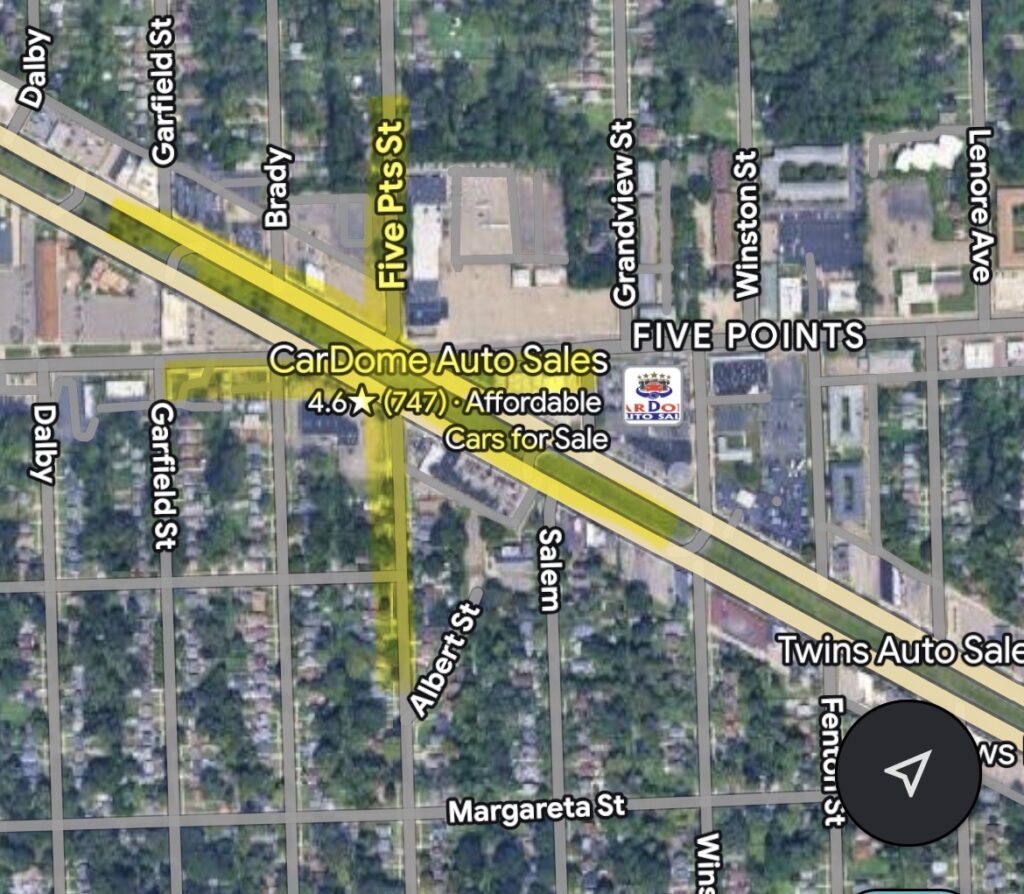
“Nation” is used in an aspirational or coalition-based sense, consistent with broader street and graffiti traditions in which the term signifies unity among otherwise independent cliques. In this context, “Nation” denotes an alliance or collective identity adopted by multiple Five Points–area crews rather than a structured organization with centralized leadership. Community accounts suggest the term gained traction during the mid-2010s as tagging crews and youth cliques began coordinating imagery, language, and territorial defense across adjacent blocks and apartment complexes.
“Crips” reflects the adoption of Crip identity, symbolism, and color usage by participating gangs. While 5PN incorporates elements commonly associated with Gangster Crips (3X / Movin’ Gang) traditions—such as hand signs, numeric references, and graffiti styles—there is no verified evidence of formal affiliation with Los Angeles–based Crip sets or any national Crip hierarchy. Usage of “Crips” within 5PN is best understood as a localized identity framework shaped by Detroit’s street ecology rather than an extension of West Coast organizational structures.
Related labels such as “5Points Crips,” “5Pointer Crips,” “ScoreGang,” “Hyena Crips,” and “83GC (Hyena Crips Got Control)” appear to function as overlapping or situational identifiers. Some are used externally by media or law enforcement, while others originate from internal graffiti practices, social-media naming conventions, or specific subsets within the alliance. These terms do not represent formal renamings of the alliance but instead reflect the fluid and decentralized nature of 5PN identity.
Overall, the etymology of 5Point Nation Crips illustrates how Detroit-based street alliances often emerge organically from shared geography, youth networks, and symbolic adoption, producing names that describe collective presence and neighborhood affiliation rather than fixed organizational lineage.
For definitions of terminology related to activity, conduct, demographics, gang-related terms, identifiers, and classifications used on this page, refer to the site glossary.
*In No Particular Order*
- ScoreGang (SCRG) / 24000 Blocc
- 5PN / 5PN Crips
- W7M Hyena Crips / W7M Hyenas
- Evergreen Telegraph Gangsters (ETG) / Evergreen-Telegraph Gangster Crips (ETGC)
- W7M 24000 Blocc Crips / W7M 24700 Blocc Crips
- Frisbee Street Crips / FSC
- Five Points Crips / Five Pointer Crips
- 5Pointz Niggaz / 5Points Gangster Crips
- 8TGC / 8TG / W7M 8TGC
- Hyena Crips / H-Gang
- Hyena Gangster Crips / Hyena Crips Gang
- West Seven Mile Crips / W7M 24700 Blocc ScoreGang
- W7M ETGC / W7M Crips
- 83GC / (W7M) 83 / West 7 Mile Eighty-Three Gangster Crips
- (W7M) 8Tray Gangsters / (W7M) 8Tray Gangsta Crips
- Westside 8Tray Crips / W7M 8Tray Crips
- Westside Rip Ridaz / Westside Crip Crazy Gang (WCCG)
- Seven Mile BaccWest Crips / BaccWest ScoreGang
- W7M 8Trays / W7M 8Treys
- 8Trays / 8Treys
For definitions of terminology related to activity, conduct, demographics, gang-related terms, identifiers, and classifications used on this page, refer to the site glossary.
Primarily the Five Points neighborhood (ZIP 48219)—their membership allegedly encompasses the entire neighborhood—northwest Detroit corridors along Seven Mile, and extensions into Redford.
Places Claimed Within Five Points
The group primarily claims West Seven Mile Road, particularly the area spanning approximately the 24000 through 24700 blocks, between Telegraph Road to the east and Five Points Street to the west. Within this small section of Northwest Detroit are numerous residential and commercial properties that the group is described as occupying, frequenting, and claiming as part of its territory.
“The Zoo” and “The Woods” are street monikers reportedly used within the 5Point Nation (5PN) alliance for two residential apartment complexes that are described as prominent gathering points and territorial landmarks within the Five Points neighborhood.
“FarrWest” (HellGang) Side of the Neighborhood
The Zoo (Four Corners Apartments)
- What it is: “The Zoo” is reportedly the street name for the Four Corners Apartments, located near Clarita Avenue and Telegraph Road.
- Why it is named that: Within local 5PN street culture, “The Zoo” is reportedly a reference to the Hyena Crips, also known as the Hyena Gangster Crips or H-Gang, a faction associated with the alliance. Because the hyena is central to the clique’s identity and its territory is referred to as the “Hyena Zone,” the apartment complex is said to have acquired the nickname “The Zoo.” The property has also been associated with ETGC (Evergreen Telegraph Gangster Crips) graffiti.
The complex is located near the former Metro by T-Mobile location around Grand River Avenue and Telegraph Road, which has been publicly associated with reported gang activity. It is also near Views Bar & Grill, with documented graffiti appearing at nearby commercial properties, including the area around Twins Auto along Grand River Avenue. Large gang-related murals have reportedly appeared in this vicinity, contributing to the area’s significance as a visible territorial landmark.
“24200 Blocc” — West Seven Mile Road / Woodbine Street
The Woods (Country House Apartments)
- What it is: “The Woods” is reportedly the street name for the Country House Apartments, a large subsidized-housing complex consisting of two distinctive two-story buildings arranged around a courtyard. The complex is located on Woodbine Street near West Seven Mile Road.
- Why it is named that: The name is primarily described as a linguistic reference to Woodbine Street, with “Woodbine” shortened by members to “The Woods.” The complex is also reportedly referred to as “LA County”or simply “Los Angeles.” These secondary names appear to reference the West Coast origins of traditional Crip culture, although that terminology should not be interpreted as evidence of an organizational connection to Los Angeles-based Crip organizations.
The complex is also located near the “7 & Telegraph” shopping plaza, reportedly referred to by some members as “TeLA.”
Both properties are described as significant neighborhood landmarks because of their residential layouts, proximity to major streets, and ability to function as gathering locations within the surrounding community.
“24700 Blocc” — West Seven Mile Road / Grandview Street
The Grandview Townhomes, also identified in some street references as “Northwest Co-Op,” are a residential cooperative housing development located around Grandview Street and West Seven Mile Road.
Location and Reported Strategic Significance
The development is situated along West Seven Mile Road, around Grandview Street and Fargo Avenue. Its significance within local accounts is attributed to two primary factors:
- The Hyena Zone: The area is described in local accounts as falling within the “Hyena Zone,” a neighborhood area associated with the Hyena/ScoreGang identity.
- The FSC Connection: The area has also been associated with the Frisbee Street Crips (FSC), a clique described in accounts of the broader 5Point Nation network.
Reported Connection to Youth Gangs
Because of its location, the Grandview Townhomes area has also been associated with the “Baby Hyenas Gang” (BHG). Local accounts describe BHG as a younger Crip-affiliated offshoot associated with the surrounding neighborhood and with activities such as territorial presence, graffiti, and participation in local “tag wars.”
“24300 Blocc” — West Seven Mile Road / Lenore Avenue
The Bellagio Liquor Shoppe, located at 24341 W. Seven Mile Road, near Wormer Avenue and Lenore Avenue, has been described as a prominent informal gathering location and highly visible territorial landmark along the West Seven Mile corridor.
Why It Is Significant to the Group
- Visual Roll Call and “BaccWest” Murals: The rear walls and alleyways surrounding the Bellagio Liquor Shoppe have reportedly displayed large blue “ETG,” “ETGC,” and “BaccWest” murals. Such graffiti functions as a highly visible territorial marker, with individual street names and monikers sometimes appearing alongside broader group identifiers.
- Informal Hub for the BaccWest Alliance: Because the property sits within the 24000–24700 block corridor of West Seven Mile Road, it has been associated with the BaccWest/ScoreGang identity and nearby 24600, 24700, and 24800 block references. Rather than functioning as a formal headquarters, storefronts, gas stations, parking lots, alleys, and other public-facing spaces can serve as informal neighborhood gathering points.
- Visibility Along the Commercial Corridor: The property’s location along West Seven Mile Road gives graffiti placed around the building considerable visibility to passing motorists and pedestrians, making the surrounding walls and alleys an important part of the area’s street-level visual landscape.
“24700 Blocc” Area — BP Gas Station
The BP gas station at 24761 W. Seven Mile Road, near the intersection with Grand River Avenue, represents another prominent commercial landmark within the area.
Faction Boundary and the “FarrWest” Connection
While the Bellagio Liquor Shoppe has been associated with the BaccWest side of the corridor, the BP location sits near a geographic transition between areas associated in local accounts with BaccWest and FarrWest/HellGang. Its position along major roadways makes it a natural point of overlap between different neighborhood areas and block identities.
Reported Crime and Property-Racketing Activity
Like other high-traffic commercial properties in the area, the BP station has been associated with reports of serious localized crime, including automobile theft and carjacking incidents. These incidents should be distinguished from evidence establishing that the property itself is controlled or operated by any particular gang.
Reported Illicit Operations and Drug Activity
The location has also been connected in local reporting to illicit activity involving the business operating at the property. In one law-enforcement investigation involving an auto-theft operation, authorities reportedly discovered an unlicensed marijuana-distribution operation associated with the premises, contributing to the property’s eventual closure.
A Location Associated With Violence and “Tag Wars”
The BP’s location at the intersection of West Seven Mile Road and Grand River Avenue places it along two major traffic corridors. The property has been associated with incidents of violent crime, including a reported triple shootingfollowing an altercation involving people in vehicles at the station.
The station’s dumpsters, rear walls, concrete barriers, and other exposed surfaces have also reportedly been used for graffiti and “throw-ups,” making the property another visible location where competing neighborhood identities can appear through tag wars and territorial graffiti.
Overall, these locations illustrate how territorial identity within the Five Points area is expressed not only through residential blocks, but also through apartment complexes, commercial properties, major intersections, storefronts, and highly visible walls along West Seven Mile Road.
For definitions of terminology related to activity, conduct, demographics, gang-related terms, identifiers, and classifications used on this page, refer to the site glossary.
*In No Particular Order*
- Crips
- Gangster Crips (3X / Movin’ Gang)
- 5Points Crips (Detroit-born)
For definitions of terminology related to activity, conduct, demographics, gang-related terms, identifiers, and classifications used on this page, refer to the site glossary.
Members (and associates/affiliates) reportedly wear blue bandannas (Navy Blue or Royal Blue) and use hand signs incorporating three fingers (associated with ‘trays/treys,’ or 3X/Movin Gang), the number 7 (referencing W. Seven Mile Road), and the letters W (‘West Side’), G (‘Gangsta/Gangster’), and C (‘Crip/Crips’). Gang tattoos include “SCRG,” “ETG,” “W7M,” “5PN,” “24700 Blocc,” “B.S.S.,” “Hyena,” “FSC,” six-pointed stars, and “7” (for “7 Mile”) or three-finger hand sign imagery. Reported graffiti identifiers include ‘83GC’ or ‘W7M 83GC’ (Hyena Crips Got Control / West 7 Mile Hyena Crips Got Control); ‘ETGC,’ ‘ETG,’ or ‘W7M ETGC’ (Evergreen Telegraph Gangster Crips / Evergreen Telegraph Gangsters / West 7 Mile Evergreen Telegraph Gangster Crips); ‘24700’ (24700 block of W. Seven Mile Road, various other block specific codes are used); ‘20-14’ (20 = T, “The”; 14 = N, “Nation”); and ‘6-16-3’ (6 = F, “Five”; 16 = P, “Pointer”; 3 = C, “Crips”). Associated colors in graffiti reportedly includes blue, black, red, and occasionally white. In conversation, on social media, and in local cultural contexts, members are often referred to as ‘5Pointers’ or ‘Hyenas.’ Tattoos associated with the 5PN Crips are not generic Crip imagery. Instead, they function as highly localized identifiers that combine group name, subset affiliation, ideological symbolism, and neighborhood representation into a single design. The lettering style is typically raw, hand-drawn, and closely resembles documented graffiti associated with the group, suggesting the use of pre-existing tag references when creating tattoo layouts. This consistency reflects a progression from temporary street markings to permanent personal identifiers, reinforcing long-term affiliation and group identity.
Within the broader 5Point Nation (5PN) / ScoreGang alliance structure, a three-point crown is reserved for members who have attained a recognized “Gangster Rank.” The crown is commonly marked with a “G” to emphasize the designation. Within 5PN culture, a “Gangster Rank” is reportedly regarded as one of the highest and most respected status classifications an individual can achieve within a participating set, crew, or clique operating under the alliance.
The 5Point Nation (5PN) alliance is widely regarded as one of the largest and most organized Crip-aligned networks in Northwest Detroit, consisting of numerous affiliated groups, crews, and neighborhood-based organizations. Within this structure, the three-point crown functions as a status symbol denoting elevated standing, seniority, influence, and earned respect.
According to gang intelligence sources and community accounts, members traditionally progress through a hierarchy of designations beginning with “Infant Gangster” and advancing through ranks such as “Baby Gangster,” “Tiny Gangster,” and “Young Gangster” before ultimately attaining the title of “Gangster.” While the exact requirements vary between individual crews and cliques, advancement is generally associated with demonstrated loyalty, participation, and long-term commitment to the organization.
Gang researchers and law enforcement sources have frequently noted that rank-related tattoos within Crip organizations are often viewed as symbols that must be earned by “putting in work,” that is, committing crimes for the gang, rather than self-assigned. Such markings may be interpreted as representing an individual’s status, reputation, or contributions within the group. Because these symbols carry significant meaning within local gang culture, displaying them without recognized affiliation can create serious safety risks, including fatal, in areas where the groups are active.
The significance of these identifiers was highlighted in an August 2025 Detroit News report examining Detroit’s gang-graffiti culture, which noted that misinterpreting or improperly displaying gang symbols can have serious real-world consequences. Within the ScoreGang / 5PN environment, rank tattoos, crowns, stars, and related markings are often treated as indicators of identity, affiliation, and standing rather than merely decorative artwork.
Additional tattoo motifs include dice displaying a pair of threes, which is an arrangement meant to emphasize the number six, often with alternate faces shaded out to highlight a total value of six. These designs reference longstanding Midwestern Crip symbolism and local interpretations of Crip identity. Members are also known to wear six-pointed stars, which serve a dual purpose: representing the broader “6” symbolism associated with regional Crip culture while simultaneously referencing neighborhood affiliation and local identity within the Five Points community.
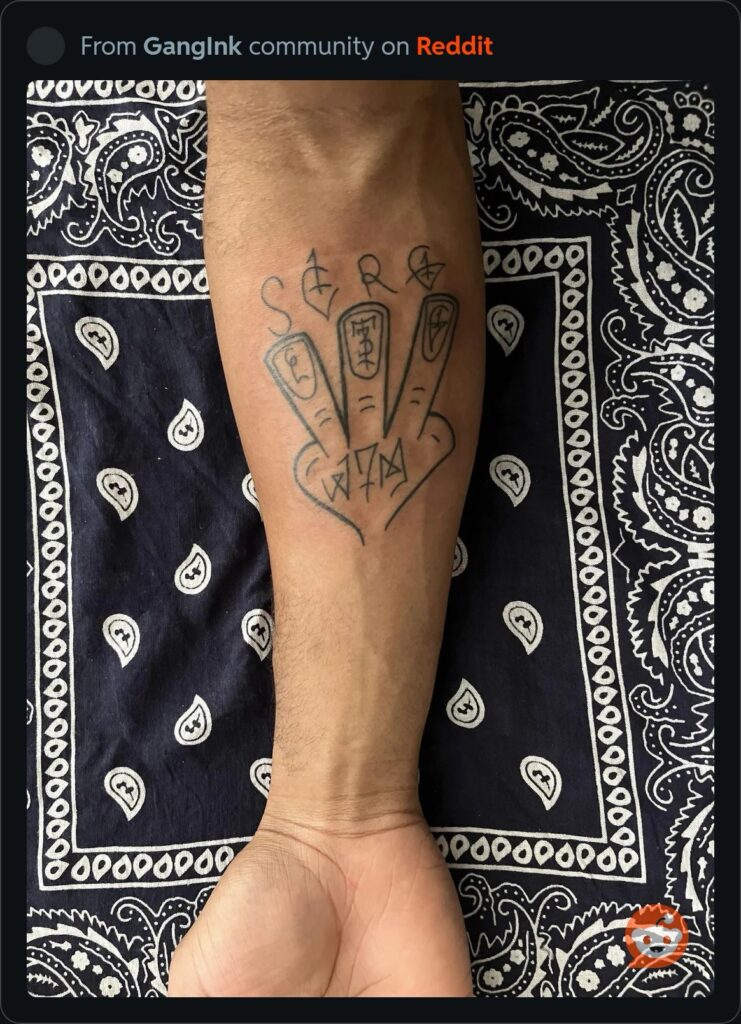
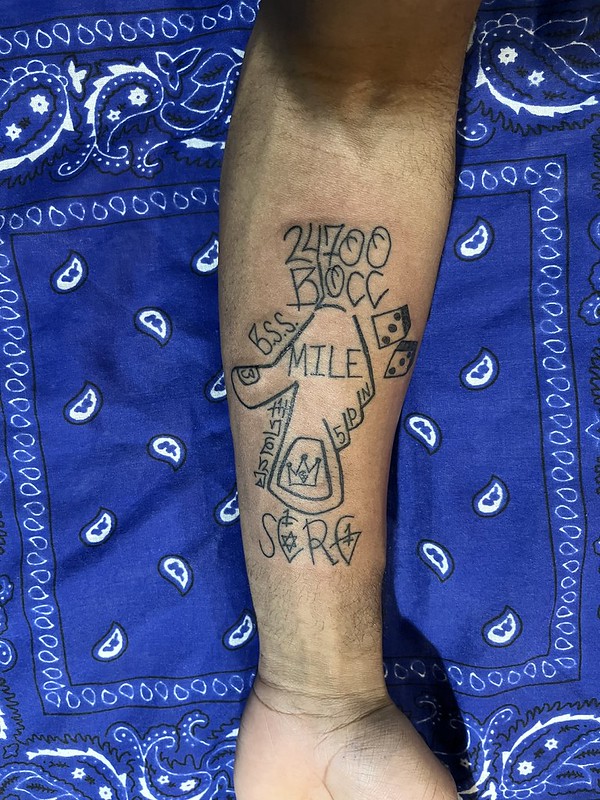
Positioned above the hand sign is “24700 Blocc,” identifying the wearer with a specific subset or originating clique within the broader ScoreGang alliance. The 24700 Blocc Crips are widely regarded in local accounts as one of the foundational groups responsible for introducing and shaping the Crip identity within the Five Points / 48219 area of Detroit.
At the base of the tattoo is “SCRG” (ScoreGang), accompanied by a Star of David and a “1” embedded inside the “C,” symbolizing “Crips First” and reflecting broader Midwest Crip symbolism adopted by various Detroit-area sets. The fingers display “5PN” (Five Point Nation), referencing a local neighborhood-based alliance structure associated with the group.
Additional identifiers include “HYENA” (with a 1 in the “H” for “Hyenas first”) placed between the thumb and index finger, referencing another internal nickname or faction identifier (e.g., “Hyena Crips,” or “Hyena Gangster Crips”), and “B.S.S.” above the thumb web, standing for “Bloc Side Soldiers,” a graffiti-oriented youth crew believed to predate the formation of ScoreGang itself. Within local gang culture, B.S.S. symbolism is associated with longtime membership, seniority, and status.
The tattoo also incorporates a three-point crown containing the letter “G,” referencing the internal “Gangster” rank — considered among the highest status designations within the organization. Near the lower section of the tattoo are dice displaying either a “6” configuration or two sets of “3s,” symbolizing both the group’s use of “6” symbolism and its alignment with “trey” / “3X” (“Movin Gang”) identity traditions commonly referenced within certain Crip-affiliated circles.
Photographed in Detroit, Michigan, USA, on May 12, 2026, against a royal blue paisley-patterned bandana background.
For definitions of terminology related to activity, conduct, demographics, gang-related terms, identifiers, and classifications used on this page, refer to the site glossary.
*In No Particular Order*
- Graffiti-related vandalism
- Minor street-level disputes
- Assaults
- Robberies
- Shootings
- Auto-thefts / joyriding
- Loitering and quality of life citations
- Transit fare evasion
- Alleged neighborhood-level intimidation
- Low-level fraud
- Theft-related incidents
- Reported disruptions of lawful or public meetings
- Small-scale narcotics possession or distribution
As with many Detroit gangs, documentation varies, and not all claims are consistently corroborated by public court records.
For definitions of terminology related to activity, conduct, demographics, gang-related terms, identifiers, and classifications used on this page, refer to the site glossary.
The most fierce rivals of the ScoreGang Crips (SCRG) are the Black P. Stone Bloods (“P. Stone Bloods,” “Jungle Stone Bloods,” “JSB,” or “BPS”), a street gang with whom they have engaged in ongoing “tag wars” throughout the Five Points neighborhood. According to official Detroit neighborhood boundaries, Five Points spans the area between Eight Mile Road to the north, Grand River Avenue to the south, Telegraph Road to the east, and Five Points Street to the west. The neighborhood is primarily associated with ScoreGang/SCRG, historically and locally known by identities including the “Frisbee Street Crips” (FSC), “Hyena Gangster Crips,” “24700 Blocc Crips,” and “W7M ETGC.” Five Points is also home to the small street-level “Bloods” gang known as the Wormer Avenue Bloods (WAB), which community documentation describes as a renegade offshoot of Detroit’s Black P. Stone Bloods operating near Seven Mile and Wormer Avenue.
SCRG/FSC is identified as the numerically larger of the two groups, with an estimated 75 to 100 or more members, while the Wormer Avenue Bloods are estimated to have just over two dozen. Other street-level groups and cliques reportedly operate in the area, including the North Side Gutta Ave Crips (NSC), 24000 Blocc Crips, 19000 Blocc Crips (Bloc19), Baby Hyenas Gang (BHG), Tiny Lok Krew (TLK), 26Gang (26G), and the North Side Soldier Boyz (NSS Boyz). These groups are described as operating within the broader “5Point Nation” alliance and maintaining an alliance with SCRG/FSC. Other non-affiliated groups, including the West Side Way (WSW) and Way Out Bombing (WOB) tagger crews, have also been associated with the neighborhood. Taken together, these groups are estimated to account for approximately 180 to 200 gang and street-group members in the area.
Five Points encompasses roughly 0.4 square miles and has an estimated population of approximately 3,000 residents. Based on those figures, an estimated 6% to 7% of the neighborhood’s population could be considered active gang or street-group members, with the overwhelming majority being Crips-affiliated. If accurate, that proportion would rival or exceed the estimated concentration associated with some nationally known Crip-affiliated street gangs, including the Rollin’ 60s Neighborhood Crips in the Hyde Park neighborhood of Los Angeles, California. The Rollin’ 60s have been reported as having approximately 1,600 members within a neighborhood of roughly 29,000 residents, meaning their estimated membership would represent approximately 5.5% of Hyde Park’s total population.
The “tag wars” between W7M ScoreGang and the Black P. Stones refer to an aggressive, localized street-graffiti conflict in northwest Detroit, particularly around Five Points and the W. 7 Mile Road (48219) corridor. W7M ScoreGang, also identified as W7M ETGC/FSC, is described as a decentralized, hybrid, neighborhood-first Detroit street gang that identifies with the Eight Trey (or “8Tray”) Gangster Crip tradition. “W7M” refers to West 7 Mile, while the group is aligned with local 3X (“Movin”) Crip factions.
The Black P. Stones (BPSN / W7 BPS), meanwhile, are described as a local faction of the Almighty Black P. Stone Nation (BPSN), a historic Chicago-founded street organization associated with the People Nation alliance. In this area, the group reportedly includes or overlaps with localized identities such as the “Jungle Stone Bloods” (JSB) and “P. Stone Bloods.” Their territory includes the Seven Mile–Rouge neighborhood, which according to official Detroit city boundaries is bounded by Eight Mile Road to the north, Grand River Avenue to the south, Berg Road to the east, and Telegraph Road to the west. Various local accounts describe the area as longstanding territory associated with the Black P. Stone Bloods. The BPS are characterized as a moderately sized, longstanding Bloods street gang with connections to out-of-state factions based in Chicago and Los Angeles. Investigators identify the group as a major rival of SCRG/FSC, with the two groups reportedly involved in a prolonged and violent feud over claimed territory, in part because their respective neighborhoods directly border one another. Another “Bloods” gang also operates in the neighborhood, though much smaller, known as the Appleton Street Bloods (A-Block), who have an alliance with the Wormer Ave Bloods (WAB), called the “Rouge Ave Bloods.”
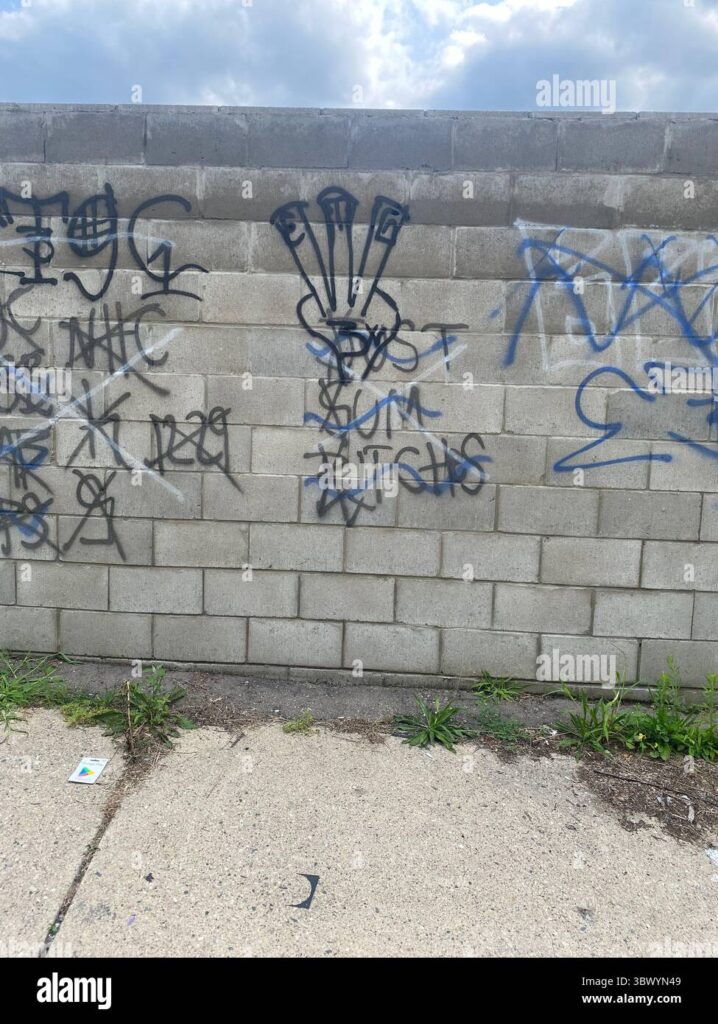
In Detroit street-gang and graffiti culture, a “tag war” occurs when rival groups deliberately cross out, overwrite, or otherwise deface one another’s graffiti to challenge territory, disrespect an opposing group, and assert dominance. Around Five Points, including alleyways, abandoned apartment complexes, and other structures, the rival groups have engaged in extensive overlapping tagging. ScoreGang identifiers reported in the area include “83GC,” “ETGC,” “ScoreGang,” “W7M,” and “24K Blocc,” while Black P. Stone markings are reportedly crossed out or overwritten. Other hostile markings include “BPSK” and “Just Sum Bitches,” a play on the acronym “JSB.”
The presence of threatening graffiti can provide investigators with important context when determining whether vandalism is part of a broader pattern of intimidation or an ongoing conflict. However, the legal significance of a specific marking depends on the surrounding facts, evidence, intent, jurisdiction, and circumstances in which it was created. A threatening acronym such as “BPSK” may therefore be treated differently from ordinary graffiti when investigators establish that it was directed at an identifiable rival group and formed part of a broader pattern of threats or violence. By itself, however, such a marking should not automatically be characterized as establishing a particular felony or proving an intent to commit violence.
Graffiti conflicts can also contribute to an atmosphere of intimidation in neighborhoods experiencing gang disputes. When hostile markings appear on active businesses, apartment buildings, or other highly visible locations, residents may interpret them as warnings connected to an ongoing conflict. This can contribute to fear of retaliation and reluctance to cooperate with investigators. In this context, graffiti can function not merely as property damage, but as a visible indicator of territorial disputes and escalating tensions.
Investigative reporting, including reporting by The Detroit News, has documented how gang-related graffiti, numerical identifiers, and acronyms can provide investigators with information about relationships, rivalries, and territorial disputes. When such markings correspond with other evidence of an active conflict, they may become part of a larger investigative picture rather than being treated as isolated acts of vandalism.
The Seven Mile–Rouge neighborhood is described as the base of the BPS street gang in Detroit and is roughly bounded by Eight Mile Road to the north, Grand River Avenue to the south, Berg Road to the east, and Telegraph Road to the west. The area is associated with the Black P. Stone Bloods, also referred to locally as the P. Stone Bloods or Jungle Stone Bloods (JSB). The BPS are described as a longstanding Bloods-affiliated street gang with connections to factions outside Detroit, including Chicago and Los Angeles. Investigators identify the group as a major rival of SCRG/FSC, with the two groups reportedly involved in a prolonged territorial feud partly because their respective areas directly border one another.
SCRG/FSC is also locally identified as “ScoreGang” or the “West 7 Mile Evergreen-Telegraph Gangster Crips” (W7M ETGC). Nearby areas further complicate the territorial picture. The Berg–Lahser area, roughly bounded by Eight Mile Road to the north, West Seven Mile Road to the south, Lahser Road to the east, and Berg Road to the west, is associated with the Rollin’ 40s and Rollin’ 60s Neighborhood Crips. These groups are described as major Crip rivals of SCRG/FSC and the broader “5PN Crips” network, which is characterized as a larger Crip-affiliated street-gang alliance operating throughout the surrounding area.
South of Five Points, the neighborhood known as “The Eye” has reportedly experienced intermittent Crip activity involving groups such as the Rollin’ 100s Neighborhood Crips (R100NHC), including related identities such as the 113 Original Blocc Crips (113 OBC). The (Y.L.S.) 107 Hoover Criminals Gang (107 HCG) has also reportedly frequented the area, although these groups are described as having a more limited presence than established Crip-affiliated groups operating throughout the broader corridor, such as ScoreGang and the Rollin’ 60s Crips (RRSC).
Taken together, this territorial and graffiti information provides context for a violent incident that occurred in late 2025 within an area already associated with rival street-gang activity.
On December 18, 2025, a violent double homicide occurred in Five Points, Detroit, Michigan, on the 19000 block of Fenton Street, an area described as being affected by the rivalry between West 7 Black P. Stone (BPS) and W7M ScoreGang Crips (SCRG). The shootings occurred in a narrow alleyway behind an apartment complex on the 19000 block of Fenton Street, within the Five Points corridor on Detroit’s west side.
Local documentation and accounts have linked the killings to the broader “tag war” conflict, describing a long-running feud involving the crossing-out, overwriting, and vandalizing of rival territorial graffiti. The reported clash involved BPS, described locally under identities including Jungle Stone Bloods (JSB), and SCRG, also identified as ScoreGang, Frisbee Street Crips, 24700 Blocc Crips, or Evergreen Telegraph Gangster Crips.
SCRG is further described in local accounts as a heavily armed, neighborhood-based street gang that developed in part from a local youth graffiti crew known as the Bloc Side Soldiers (B.S.S.). Those accounts characterize the group as having grown to more than 100 members and developed a significant presence along the West 7 Mile corridor.
It’s not easy to quantify fear, but the Detroit Police Department’s Organized Crime Bureau took a gallant stab at the problem when Captain John Stewart spoke with the Detroit News in August 2025 about volatile “tag wars” in the Five Points neighborhood. Stewart stated on the record that there are “dozens” of Crip spinoffs within the city, one of the largest being the Rollin’ 60s Crips, with more than 150 documented members. According to community accounts citywide, total Crip gang membership is estimated at roughly 900 to 1,000 individuals (across ~36 different groups or “sets”). According to Stewart, membership can involve individuals responsible for graffiti-related vandalism, conflicts that can escalate into fatal violence due to what he described as a “lack of conflict resolution skills.” In any other major city (or country), such assemblies of heavily-armed young men and women might merit a stronger description than simply “gangs”—armies, perhaps.
Reported rivalries include:
*In No Particular Order*
- Neighborhood Crip sets, primarily the Rollin’ 60s and Rollin’ 40s
- Blood-affiliated gangs, mainly the Black P. Stone Bloods / Jungle Stone Bloods (JSB) and Wormer Ave Bloods street gangs
- Appleton Street Bloods / Rouge Ave Bloods
Reported allies include:
For definitions of terminology related to activity, conduct, demographics, gang-related terms, identifiers, and classifications used on this page, refer to the site glossary.
The 5Point Nation (5PN) functions as a coalition of smaller cliques rather than a single gang:
*In No Particular Order*
- ScoreGang (SCRG) / ETGC (Evergreen Telegraph Gangster Crips) — A large, predominantly African-American, violent street gang involved in “tag wars” and various other forms of criminality in Detroit’s Five Points neighborhood.
- 19000 Blocc (Bloc19) — A small street clique from Winston street, often linking with the larger “24500 Blocc Crips” calling themselves the “19-45 Crips” and actively in violent street-level conflicts with the Wormer Ave Bloods (a renegade Black P. Stone Bloods street clique).
- 24000 Blocc (24BLK) — 24000 Blocc (24BLK) — A broad umbrella grouping encompassing the 24200–24800 Blocc Crip affiliations, with no known 24400 Blocc set. Within this broader structure, the West 7 Mile Evergreen Telegraph Gangster Crips (W7M ETGC) can be characterized as a geographically organized alliance of neighborhood-based “Blocc” affiliations and street cliques concentrated along the W. Seven Mile Road corridor between Telegraph Road and Five Points Street. The network is reportedly associated with several apartment complexes, townhome developments, and vacant or abandoned properties throughout the area, including Country House Apartments (“The Woods”/“LA County”), Four Corners (“The Zoo”), Northwest Co-Op (“Grandview Townhomes”), and the former Beyond The Gates complex. Rather than functioning as a single, homogeneous street clique, W7M ETGC appears to encompass a network of geographically defined subgroups associated with specific streets and residential blocks. These include the 24200, 24300, 24500, 24600, 24700, and 24800 Blocc Crips, along with smaller cliques operating within or around their respective territories. The subgroups also maintain additional geographic and social alliances that further organize the broader network. BaccWest, consisting of the 24600, 24700, and 24800 Blocc Crips, is described as one of the more active internal coalitions, while FarrWest links the 24200, 24300, and 24500 affiliations. Individual areas contain distinct cliques—including Frisbee Street Crips (FSC), Bloc19, and BigJumpShotGang (BJSG)—that may retain separate identities while remaining connected to the larger alliance. Taken together, these overlapping affiliations make W7M ETGC more accurately characterized as a multi-layered neighborhood network or umbrella alliance rather than a single, centrally structured gang. Its internal organization is largely shaped by geography, neighborhood identity, and relationships between individual Blocc affiliations and cliques. At the same time, interactions with neighboring Blood-affiliated groups, particularly in connection with graffiti disputes and retaliatory conflicts, contribute to an often fluid and volatile local gang environment.
- Two-Syxx Gang / 26Gang (26G) — A youth spinoff gang of the “Hyena Crips” or “Hyena Gangster Crips” often involved in petty crime and vandalism.
- Tiny Lok Krew / Tiny Laughers Krew (TLK) — A locally notorious gang-affiliated “tagger crew” whose street-level output stays mostly to graffiti and crossouts.
- Baby Hyenas Gang (BHG) — An extremely active youth wing of the broader ScoreGang / W7M ETG street gang, involved in the local “tag wars.”
- Lil Mad Daly Boyz (LMDB) — A Redford-based street clique that was started by members of the “24300 Blocc Crips.”
- NSS Boyz — A founding street clique and graffiti crew from the Five Points neighborhood.
- Bloc Boy Flocc (B.B.F.) — A youth violent street clique operating under the “24700 Blocc Crips.”
- Northside Gutta Ave Crips (NSC) — A small street gang subgroup made up of the “FarrWest Alliance” members.
- BigJumpshotGang (BJSG) — A violent youth wing of the “Baccwest Alliance.”
- Insane Angels Gang (I.A.G.) — A predominantly female-led street clique from the Brightmoor and Old Redford areas.
These subsets operate semi-independently while maintaining the broader 5PN identity across Five Points and surrounding areas.
For definitions of terminology related to activity, conduct, demographics, gang-related terms, identifiers, and classifications used on this page, refer to the site glossary.
The 5PN alliance is noted for its influence on Detroit’s underground graffiti scene and local street culture. Members’ tags and music often reference neighborhood identity, territorial pride, and alliance with the “ScoreGang” or “Hyena Crips Got Control” identity. Their social presence reinforces local awareness of their turf and alliances.
For definitions of terminology related to activity, conduct, demographics, gang-related terms, identifiers, and classifications used on this page, refer to the site glossary.
The 5Point Nation Crips (5PN) are documented as a predominantly African American, Detroit-based Crip-aligned street gang alliance that began forming between 2015 and 2016. The gang traces its origins to two youth graffiti crews—the Bloc Side Soldiers (B.S.S.), which was founded by Zahid Sekou (a/k/a “Tiny Joker”), and the North Side Soldiers (N.S.S.), which was also founded by Tiny Joker, whose overlap in membership and territory gradually led to the development of a broader neighborhood identity. As additional Five Points–area tag crews began cooperating, several adopted Crip symbolism and incorporated what participants referred to as 5Point Nation literature, an internal doctrine cited in a 2025 Detroit News feature on local tagging conflicts. The 5Point Nation’s Literature (allegedly compromised of approximately 25 sections) is governed by their internal council, known as the ‘Nation Board.’
By the early 2020s, sources noted a decline in Blood-affiliated activity within the Five Points area, accompanied by a marked increase in 5PN graffiti, tagging, and iconography across the 48219 ZIP code and adjacent neighborhoods. Although 5PN incorporates elements associated with West Coast Crip culture, there are no verified organizational ties to Los Angeles Crip structures or any national governing body.
Rather than functioning as a single gang, 5Point Nation is best understood as a multi-clique alliance, rooted primarily in Detroit’s far-northwest side. It encompasses a mix of local Crip-identified street cliques and tagging crews—each with its own leadership, membership, and neighborhood base—while sharing a collective Five Points identity.
- 1. Infant Gangster (IG): The absolute entry tier for the youngest recruits or prospects. They have no decision-making power and are primarily tested on basic reliability.
- 2. Baby Gangster (BG): Early-stage initiates who have formally integrated into the group. They are typically responsible for lower-risk street logistics, lookouts, and basic neighborhood tagging.
- 3. Tiny Gangster (TG): The highly active, front-line enforcement rank (or “shooters”). Members at this stage direct the street-level youth crews, engage directly in territory defense, and execute strategic “tag wars”.
- 4. Young Gangster (YG): Experienced mid-tier operators. They act as intermediaries between the senior leadership and the younger street crews, ensuring internal laws are followed.
- 5. Gangster (G): The highest status classification within the organization. Distinguished by a three-point crown tattoo containing the letter “G” (representing “Gangsters First,” or “Gangster Rank”), these senior figures direct the overall alliance strategy, territorial mapping, and group diplomacy.
For definitions of terminology related to activity, conduct, demographics, gang-related terms, identifiers, and classifications used on this page, refer to the site glossary.
Recruitment into the 5Point Nation Crips / W7M ETGC appears to occur informally, primarily through participation in youth graffiti activity and local tag crews in Detroit’s Five Points neighborhood, reflecting the gang’s origins in such networks. This mode of recruitment is consistent with broader patterns observed in Detroit, where gangs often emerge from loosely organized, youth-led cliques rather than through formalized doctrines or initiation processes. Neighborhood-based associations and school-related rivalries further contribute to recruitment, drawing adolescents from the 48219 area amid ongoing territorial tensions.
According to local accounts, members of the 5PN Crips could allegedly be initiated in one of three ways. First, a prospective member could be “put-on,” a process reportedly requiring the individual to fight or withstand a beating from another member or members for at least 60 seconds. Alternatively, someone could receive “the race,” in which another member would bring the individual into the gang while requiring the new member to participate in some form of criminal activity within 24-hours, reportedly including vandalism, such as a “tagging mission,” or violence. Finally, an individual could allegedly be “blessed-in” to the gang with the consent of the existing members of a particular clique or crew. Upon initiation, new members were reportedly provided with 5Point Nation literature containing the organization’s alleged by-laws and other information. Membership has been described as hierarchical, with ranks listed in ascending order as “Infant Gangster” (Infant), “Baby Gangster” (BG), “Tiny Gangster” (TG), “Young Gangster” (YG), and “Gangster” (G). According to these accounts, each rank carries particular responsibilities or roles. For example, the role of “shooter,” reportedly associated frequently with the “Tiny Gangster” (TG) rank, allegedly involves protecting other members. Accounts further allege that 5PN Crips members are expected to support fellow members during fights and other criminal activity. Members who allegedly violate organizational rules—such as failing to know the by-laws, failing to attend neighborhood meetings, or refusing orders from higher-ranking members—have reportedly been subject to internal punishment, sometimes described as being “violated,” including beatings, shootings, or stabbings. According to these same accounts, members could advance in rank or demonstrate loyalty to the 5PN Crips by “putting in work.” Reported examples of “putting in work” include placing 5PN Crips and/or ScoreGang (SCRG) graffiti in various locations, committing robberies, home invasions, carjackings, and drive-by shootings, and fighting with rival gangs or groups. The 5PN Crips and its member group, ScoreGang (SCRG), have also been described in reporting and local accounts as being heavily armed. Some accounts allege that firearms are frequently shared among members, stored at other members’ residences, or purchased from one another.
For definitions of terminology related to activity, conduct, demographics, gang-related terms, identifiers, and classifications used on this page, refer to the site glossary.
The gang’s presence in Detroit’s Five Points neighborhood has been associated with localized public safety concerns, primarily related to territorial disputes and the use of visible markers such as graffiti. These indicators point to ongoing street-level tensions rather than large-scale or formally organized criminal activity documented by law enforcement. Recorded graffiti exchanges suggest periodic interactions with other established criminal street gangs operating in or near the area, including the Black P. Stone Nation, the Rollin 60s Crips, and various local gangs and tagger crews. Over time, these interactions have manifested as sustained efforts to assert territorial presence through escalating graffiti conflicts—commonly referred to as “tag wars”—and related street confrontations. This pattern is consistent with broader dynamics of rivalry-driven territorial assertion observed among Detroit-based gangs. Reporting by The Detroit News notes that a purported Crip-affiliated individual from the area has documented these tag wars, which police characterize as potential early indicators of violence linked to attempts at establishing control.
For definitions of terminology related to activity, conduct, demographics, gang-related terms, identifiers, and classifications used on this page, refer to the site glossary.
Five Points Detroit Crime, Graffiti, Gunfire, and Gang Activity: An Evidence-Based Overview
Crime, Graffiti, and Public Safety in Five Points, Detroit
Understanding crime and gang-related activity in Five Points, Detroit, requires careful consideration of how different public and private data sources classify and report criminal incidents. Available statistics indicate persistent concerns involving property crime, vandalism, gunfire, and violent crime, while also illustrating the limitations of publicly available data when attempting to attribute individual incidents to specific Detroit street gangs or neighborhood-based groups.
Detroit Police Department Crime Reporting and Graffiti
The Detroit Police Department (DPD) does not publicly report illegal graffiti as a standalone offense category within its regularly released crime statistics. Graffiti-related incidents are generally recorded within broader property-crime classifications, including vandalism or malicious destruction of property, consistent with applicable FBI Uniform Crime Reporting (UCR) offense definitions.
In 2025, DPD reported 11,382 property-crime incidents across Detroit’s westside precincts. However, publicly available reporting does not further disaggregate those figures by individual precinct and specific offense type in a manner that would permit reliable calculation of graffiti incidents specifically within Five Points. Consequently, citywide or westside property-crime totals should not be interpreted as a direct measurement of graffiti activity in the neighborhood.
This distinction is particularly important when examining Detroit street gang graffiti, territorial markings, and alleged gang-related vandalism. The presence of graffiti may provide contextual evidence of neighborhood-level territorial disputes, but graffiti alone does not establish the identity, organizational affiliation, or criminal responsibility of the individuals responsible.
Gunfire and Shot Detection Activity in the Five Points Area
Gunfire-detection data provides an additional source of information concerning public-safety conditions in and around Five Points. ShotSpotter data associated with Detroit’s 8th Precinct, which encompasses the Five Points area, indicates sustained detected-gunfire activity during 2025.
Spatial mapping of these detections shows a concentration of reported shooting incidents in the southern portion of Five Points, particularly in areas between West Seven Mile Road and Grand River Avenue. Such geographic clustering is relevant to understanding the distribution of firearm-related activity within the precinct.
Importantly, however, detected gunfire should not automatically be characterized as gang-related. Nor should the geographic concentration of shootings be interpreted as evidence that any particular Detroit gang, crew, or neighborhood organization was responsible. Establishing gang involvement requires corroborating investigative or law-enforcement evidence beyond the location of a reported or detected shooting.
Five Points Crime Statistics and Risk Assessments
Third-party crime-analysis platforms provide additional estimates concerning crime and vandalism in Five Points, although these sources use different methodologies, geographic boundaries, observation periods, and statistical models. Their figures should therefore be treated as contextual indicators rather than interchangeable official crime statistics.
Augurisk has characterized Five Points as a neighborhood with elevated crime risk. Its historical estimates, based on observations from approximately 2017 through 2021, identify an average of roughly 76 acts of vandalism per year, corresponding to a reported severe-risk classification. The platform also estimates approximately 113 violent crimes and 348 property crimes per year, along with approximately 80 motor-vehicle thefts, depending on the geographic unit analyzed.
Augurisk’s assessment describes the overall crime risk in Five Points as severe. Because these estimates are derived from historical observations and block-group-level modeling, they should not be presented as equivalent to current Detroit Police Department incident totals.
More recent estimates from HomeSnacks likewise indicate elevated reported crime levels. For 2023, HomeSnacks reported approximately 287 crimes in Five Points, consisting of 121 violent crimes and 166 property crimes. The resulting estimated crime rate was approximately 10,533 crimes per 100,000 residents, substantially above the national average according to the site’s methodology.
Other crime-ranking services produce similar, although not identical, assessments.
According to DoorProfit, Five Points has an overall crime index of approximately 153, compared with a national benchmark of 100. The platform places Five Points approximately 53% above that national benchmark and reports that the neighborhood is safer than approximately 54% of Detroit neighborhoods. DoorProfit’s reported Detroit comparison index is approximately 141, placing Five Points roughly 12% above the Detroit average according to its methodology.
Among individual crime categories, DoorProfit identifies burglary as one of the neighborhood’s more elevated concerns, assigning it an index of approximately 142, or 42% above its stated national benchmark.
AreaVibes similarly assigns Five Points an “F” crime grade and reports a high estimated likelihood of victimization, stating that residents face approximately a 1-in-10 chance of becoming a crime victim. These figures are model-based estimates and should be interpreted accordingly rather than as a literal probability applicable uniformly to every resident, address, or time period.
CrimeGrade Assessment of Five Points
CrimeGrade assigns the Five Points neighborhood an overall “D” crime grade. Its methodology combines violent crime, property crime, and other categories and compares the resulting rate with the average U.S. neighborhood.
CrimeGrade places Five Points in approximately the 20th percentile nationally, meaning that its modeled crime rate is higher than that of roughly 80% of the neighborhoods included in its comparison set.
The platform estimates an overall crime rate of approximately 59.09 incidents per 1,000 residents in a typical year. CrimeGrade’s mapping also indicates geographic variation within Five Points, with the northwest portion generally identified as comparatively safer.
According to the platform’s geographic analysis, estimated victimization risk varies across different portions of the neighborhood. CrimeGrade identifies the southwest area—roughly the area bounded by West Grandview Street, Seven Mile Road, Grand River Avenue, and Telegraph Road—as having a modeled victimization probability of approximately 1 in 16, while its northwest area is modeled at approximately 1 in 19.
When incidents are measured by total volume rather than population-adjusted rates, CrimeGrade estimates that the northwest portion of Five Points accounts for approximately 81 incidents annually, while the western portion accounts for approximately four incidents annually. These figures illustrate why population-adjusted rates and raw incident counts should not be treated as interchangeable measures of neighborhood safety.
Estimated Economic Cost of Crime in Five Points
CrimeGrade’s 2025 modeling also estimates the economic cost of crime in Five Points at approximately $5.22 million, equivalent to roughly $1,179 per resident and $2,615 per household. The platform estimates that these costs represent approximately 4.4% of median household income.
According to CrimeGrade’s methodology, the estimated economic burden is distributed among three principal categories:
- 48.3% — Criminal justice system costs, including law enforcement, courts, and incarceration.
- 40.4% — Direct victim costs, including property damage, medical expenses, and lost wages.
- 11.3% — Lost economic contribution, including costs associated with incarceration and repeat offending.
CrimeGrade estimates the annual cost of crime per Five Points resident at approximately $1,179, or about $714 higher than its national comparison figure and approximately $692 higher than its Detroit city comparison figure.
Because Five Points is a relatively small neighborhood—approximately 3,000 residents across roughly 0.4 square miles, depending on the geographic definition used—per-capita crime estimates can produce substantial numerical differences from larger neighborhoods or jurisdictions. Geographic boundaries also matter considerably when comparing Five Points with surrounding communities.
Five Points is generally described as bounded by Eight Mile Road to the north, Grand River Avenue to the south, Telegraph Road to the east, and Five Points Street to the west, creating a compact and distinctive geographic area adjacent to the Redford Charter Township border.
Detroit Gang Graffiti and the “Tag Wars” in Five Points
The relationship between graffiti, territorial identity, and Detroit street gangs received significant public attention in 2025.
In August 2025, The Detroit News reported on so-called “tag wars” in the Five Points area—street-level conflicts involving graffiti, territorial markings, and competing neighborhood groups. The reporting included comments from the Detroit Police Department’s Organized Crime Division, which indicated that disputes involving graffiti and territorial identity can escalate beyond property damage and contribute to serious, potentially fatal violence.
The same reporting identified a localized group known as ScoreGang and described it as a subset of the Crips. Such descriptions should be attributed to the reporting source and not treated as independent confirmation of every alleged affiliation, individual membership, or criminal act associated with the group.
This distinction is essential when documenting Detroit gang activity, gang graffiti, territorial disputes, and neighborhood violence. A graffiti tag, shooting location, or other isolated incident may indicate a broader pattern worthy of investigation, but none of those indicators by themselves establishes that a particular gang committed a specific offense.
What the Available Data Does—and Does Not—Show
Taken together, the available crime statistics, gunfire-detection data, crime-risk models, and journalistic reporting provide evidence of elevated public-safety concerns in Five Points, Detroit, including reported violent crime, property crime, vandalism, firearm activity, and territorial graffiti disputes.
At the same time, the available datasets have significant methodological limitations. DPD’s publicly released crime statistics do not provide a sufficiently granular graffiti-specific dataset for Five Points; third-party platforms rely on different methodologies and historical periods; gunfire-detection systems identify detected acoustic events rather than the perpetrators responsible for them; and crime-risk services use modeled estimates that may differ substantially from official police incident counts.
Accordingly, the evidence supports describing Five Points as an area with documented and modeled crime concerns and a history of reported territorial graffiti disputes, but it does not support attributing every crime, shooting, vandalism incident, or graffiti marking to a particular Detroit street gang.
For researchers, journalists, residents, and anyone studying Detroit street gangs and neighborhood crime, the most defensible approach is therefore to distinguish between officially reported incidents, third-party statistical estimates, gunfire detections, and allegations of gang affiliation. Maintaining that distinction strengthens the reliability of the historical record while providing a more academically rigorous account of crime and gang-related activity in Five Points.
Notes & Verification Status
• Content reflects a mix of public records, media reporting, and community accounts.
• Intended for informational and historical reference; it is not legal documentation.
• Contemporary activity is less documented than historical presence.
• No verified connection to national Crip hierarchies.
Sources:
*Sources are listed in no particular order. Numerical placement does not indicate priority, authority, or primary-source status.*
- 1. Grokipedia 2026, 5Point Nation Crips (5PN) page
- 2. Grokipedia 2026, West 7 Mile Evergreen Telegraph Gangster Crips (W7M ETGC) page
- 3. Grokipedia 2026, Hyena Crips page
- 4. Grokipedia 2026, Five Points neighborhood, Detroit page
- 5. Detroit News Article 2025, Purported Crip-Affiliated Gang Member Documents City’s ‘Tag Wars’
- 6. 2025 Detroit Crips Mini-documentary, Most Dangerous Crip Gangs in Detroit: The Real Story of Power, Bloodshed & Survival
- 7. 2025 Detroit Bloods Mini-documentary, Most Dangerous Blood Gangs in Detroit EXPOSED: 55 Seven Mile Bloods, 82 Headbanger Bloods & More!
- 8. Alamy Stock Photos 2015-2025, “Detroit Crips Graffiti,” 330+ photos with EXIF data and detailed titles/captions used for identification and location context
- 9. Internet Archive Search, “W7M ScoreGang” shows 25 results, all with detailed infomation on the sociological aspect of their existence
- 10. Detroit Police Department Weekly Report on ShotSpotter Activity, Report Date: Monday, October 27, 2025
- 11. FBI Offense Definitions, Crime In The United States 2011
- 12. Daily Overview Crime Report, Detroitmi.gov site PDF, Tuesday, November 4, 2025
- 13. Bridge Detroit Article 2025, Detroit Police Department has mountains of crime data. Here’s how to navigate it
- 14. Detroit RMS Crime Incidents Map, Detroitmi.gov site
- 15. “Tag” definition, GangEnforcement.com
- 16. Gang Terminology, GangEnforcement.com
- 17. Street Gangs, GangEnforcement.com
- 18. Shutterstock, Five Points Local portfolio
- 19. DOJ Press Release 2026, Eighth Member of the Brooklyn-Based Hyena Crips Gang Pleads Guilty to Racketeering Crimes, Including Murder
- 20.DOJ Press Release 2019, 16 Members of a Violent Gang from Detroit’s Westside Have Been Convicted for Their Roles in a Racketeering Conspiracy
- 21. Grokipedia 2026, 7 Mile Playboy Gangster Crips page
- 22. DOJ Press Release 2022, Eight Trey Gangster Crip Sentenced to 420 Months in Prison for Drug Trafficking and Money Laundering
- 23. Grokipedia 2026, Eight Tray Gangster Crips page
- 24. Brooklyn’s DA Office 2023, Thirty-Two Alleged Members of Brooklyn-Based Gangs Variously Charged With 140 Counts, Including Conspiracy to Commit Murder
- 25. DOJ Press Release 2020, Two Members of the Brooklyn-Based “Insane Crip Gangsters” Charged with Sex Trafficking
- 26. DOJ Press Release 2015, Twenty Arrested As Federal And Local Authorities Dismantle Violent Set Of Crips Gang
- 27. DOJ Press Release 2018, Leader of Brooklyn Street Gang, Eight Trey Crips, Convicted of Murder In-Aid-Of Racketeering
- 28. DOJ Press Release 2019, Leaders and Members of Outlaw Gangsta Crips and Shoota Gang Sentenced to Up to 210 Months’ Imprisonment
- 29. Convington County Tennessee Gang Task Force, Gang Awareness In Your Neighborhood (2026)
- 30. FBI Press Release 2015, Eight Trey Crips Gang Member Arrested for Murder of Brooklyn, New York Man
- 31. DOJ Press Release 2019, Six Members and Associates of Brooklyn “Eight Trey Cowboys” and “Bloods” Street Gangs Arrested for Trafficking Narcotics and Firearms
- 32. Augurisk.com, Five Points, Detroit
- 33. AreaVibes.com, Five Points, Detroit
- 34. DoorProfit.com, Five Points neighborhood, Detroit
- 35. HomeSnacks.com Living In Five Points, Detroit, MI
- 36. AreaVibes.com, Five Points, Detroit, MI Crime Rates
- 37. CrimeGrade.org, The Safest and Most Dangerous Places in Five Points, Detroit, MI: Crime Maps and Statistics
- 38. U.S. Department of Justice, CRM 1-499; 105. Prosecuting Gang Activity
- 39. U.S. Department of Justice (OJJDP), CRIPS AND BLOODS STREET GANGS
- 40. U.S. Department of Justice (OJJDP), Hybrid and Other Modern Gangs
- 41. U.S. Department of Justice,National Drug Intelligence Center; Attorney General’s Report to Congress on the Growth of Violent Street Gangs in Suburban Areas April 2008; Appendix B. National-Level Street, Prison, and Outlaw Motorcycle Gang Profiles
- 42. U.S. Department of Justice (OJJDP), Graffiti Formats: Are They Gangs or Graffiti Crews? (Kenneth A. Davis, 2008)
- 43. U.S. Department of Justice (OJJDP), Taggers Beware: The Writing Is on the Wall (Douglas Page, 2005)
- 44. U.S. Department of Justice (OJJDP), Graffiti (Deborah L. Weisel, 2009)
- 45. U.S. Department of Justice (OJJDP), “Graffiti” library search
- 46. U.S. Department of Justice (OJJDP), Wipe Out Vandalism and Graffiti (1998)
- 47. National Gang Center (NGC), Michigan Gang-Related Legislation By State
- 48. SafeState. (n.d.); Gang mentality and behavior; Tarrant Cares
- 49. PoliceMag.com, Decoding the Secret Messages on the Wall (April 1, 1996)
- 50. Buena Vista Neighborhood Association, Why Gang Graffiti Is Dangerous (March 6, 2018)