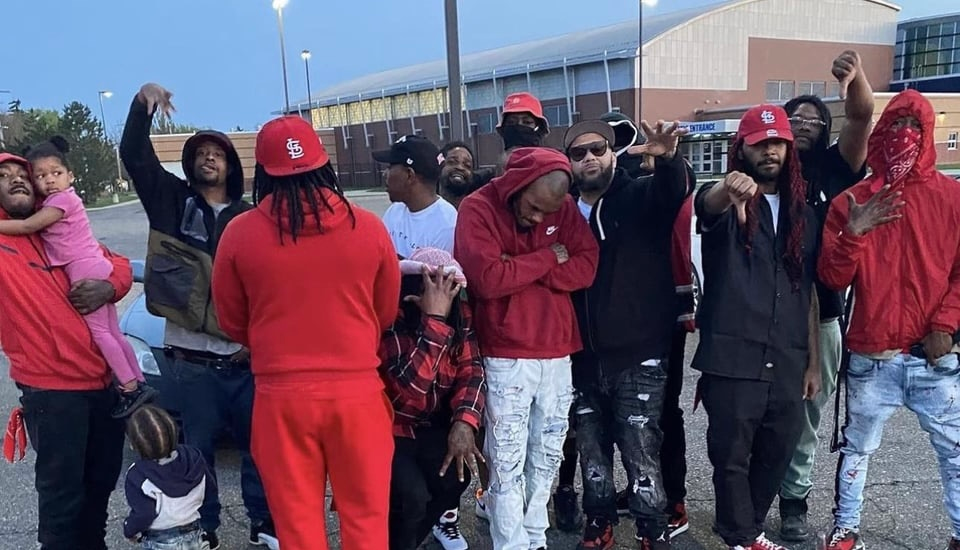
The Black P. Stone Nation—locally known as Jungle Stone Bloods—are documented as predominantly African American, and represent one of Michigan’s longest-standing Blood-affiliated criminal street gangs. Centered in Northwest Detroit, the set blends national Chicago-origin BPS culture with localized Seven Mile street identity, maintaining a steady presence through narcotics activity and long-running conflicts with Crip and Folk-aligned groups.
For definitions of terminology related to activity, conduct, demographics, gang-related terms, identifiers, and classifications used on this page, refer to the site glossary.
For definitions of terminology related to activity, conduct, demographics, gang-related terms, identifiers, and classifications used on this page, refer to the site glossary.
• BPSN
• Jungle Stones
• Black P. Stones
• JSB / M-Stones
• 07B / 7ELE
• W7 BPS / W/7 BPS
• West 7 Mile Bloods / West 7 Mile BPS
For definitions of terminology related to activity, conduct, demographics, gang-related terms, identifiers, and classifications used on this page, refer to the site glossary.
• Parts of Lansing, MI
• Northwest Detroit — 7 Mile & Lahser corridor
• 7 Mile & Telegraph area
• Seven Mile–Rouge neighborhood (entire neighborhood)
• Smaller BPS pockets in other parts of western Michigan
For definitions of terminology related to activity, conduct, demographics, gang-related terms, identifiers, and classifications used on this page, refer to the site glossary.
*In No Particular Order*
• Bloods
• People Nation (5X)
• Chicago-origin Black P. Stone tradition
For definitions of terminology related to activity, conduct, demographics, gang-related terms, identifiers, and classifications used on this page, refer to the site glossary.
• Five-point star
• Pyramid / Stone iconography
• Red bandanas (Bright Red or Dark Red)
• “BPS,” “JSB,” and “Stone Run It” graffiti; Associated colors in graffiti reportedly include red, black, and occasionally white
• Stone / 5X hand signs
For definitions of terminology related to activity, conduct, demographics, gang-related terms, identifiers, and classifications used on this page, refer to the site glossary.
• Racketeering
• Heroin and crack distribution
• Robbery
• Weapons trafficking
• Street-level disputes and intimidation
• Reported disruptions of lawful or public meetings
• Territorial graffiti
• Loitering
• Transit fare evasion
• Public intoxication
• Intimidation
For definitions of terminology related to activity, conduct, demographics, gang-related terms, identifiers, and classifications used on this page, refer to the site glossary.
Their most fierce rivals are the ScoreGang Crips (SCRG), with whom they have engaged in ongoing “tag wars” throughout the Five Points neighborhood. Five Points spans roughly the area between Eight Mile Road to the north, Grand River Avenue to the south, Telegraph Road to the east, and Five Points Street to the west. The neighborhood is described as being primarily occupied by the ScoreGang/SCRG—historically and locally known as the “Frisbee Street Crips” (FSC) and “W7M ETGC”—and the Wormer Avenue Bloods (WAB), a renegade offshoot of Detroit’s Black P. Stone Bloods operating near Seven Mile and Wormer Avenue.
SCRG/FSC is identified as the numerically larger of the two groups, with an estimated 75 to 100 or more members, while the Wormer Avenue Bloods are estimated to have just over two dozen. Several other street-level groups and cliques are also reported to operate in the area, including the North Side Gutta Ave Crips (NSC), 19000 Blocc Crips (Bloc19), and North Side Soldier Boyz (NSS Boyz), which are described as operating within the broader “5Point Nation” alliance and maintaining an alliance with SCRG/FSC. Other non-affiliated groups, including the West Side Way (WSW) and Way Out Bombing (WOB) tagger crews, have also been associated with the neighborhood. Taken together, these groups are estimated to account for approximately 180 to 200 gang and street-group members within the area.
Five Points encompasses roughly 0.4 square miles and has an estimated population of approximately 3,000 residents. Based on those figures, an estimated 6% to 7% of the neighborhood’s population could be considered active gang or street-group members, with the overwhelming majority being Crips-affiliated. That proportion (if accurate) would rival or exceed the estimated concentration associated with some nationally known Crip-affiliated street gangs, including the Rollin’ 60s Neighborhood Crips in the Hyde Park neighborhood of Los Angeles, California. The Rollin’ 60s have been reported as having approximately 1,600 members within a neighborhood of roughly 29,000 residents, meaning their estimated membership would represent approximately 5.5% of Hyde Park’s total population.
The “tag wars” between W7M ScoreGang and the Black P. Stones refer to an aggressive, localized street-graffiti conflict in northwest Detroit, particularly around Five Points and the W. 7 Mile Road (48219) corridor. W7M ScoreGang, also identified as W7M ETGC/FSC, is described as a decentralized, (hybrid) neighborhood-first Detroit street gang that identifies with the Eight Trey (or “8Tray”) Gangster Crip tradition. “W7M” refers to West 7 Mile, while the group is aligned with local 3X (“Movin”) Crip factions.
The Black P. Stones (BPSN / W7 BPS), meanwhile, are described as a local faction of the Almighty Black P. Stone Nation, a historic Chicago-founded street organization associated with the People Nation alliance. In this area, the group is reported to include or overlap with localized identities such as the “Jungle Stone Bloods” (JSB) and “P. Stone Bloods.”
In Detroit street-gang and graffiti culture, a “tag war” occurs when rival groups deliberately cross out, overwrite, or otherwise deface one another’s graffiti to challenge territory, disrespect an opposing group, and assert dominance. Around Five Points, including alleyways, abandoned apartment complexes, and other structures, the rival groups have engaged in extensive overlapping tagging. ScoreGang identifiers reported in the area include “83GC,” “ETGC,” “ScoreGang,” “W7M,” and “24K Blocc,” while Black P. Stone markings are reportedly crossed out or overwritten. Other hostile markings reportedly include “BPSK” and “Just Sum Bitches,” a play on the acronym “JSB.”
The presence of threatening graffiti can give investigators important context when determining whether vandalism is part of a broader pattern of intimidation or an ongoing conflict. However, the legal significance of a specific marking depends on the surrounding facts, evidence, intent, jurisdiction, and the circumstances in which it was created. A threatening acronym such as “BPSK” may therefore be treated differently from ordinary graffiti when investigators can establish that it was directed at an identifiable rival group and formed part of a broader pattern of threats or violence. It should not, by itself, be characterized as automatically establishing a particular felony or proving an intent to commit violence.
Graffiti conflicts can also contribute to an atmosphere of intimidation within neighborhoods experiencing gang disputes. When hostile markings appear on active businesses, apartment buildings, or other highly visible locations, residents may interpret them as warnings connected to an ongoing conflict. This can contribute to fear of retaliation and reluctance to cooperate with investigators. In this context, graffiti can function not merely as property damage, but as a visible indicator of territorial disputes and escalating tensions.
Investigative reporting, including reporting by The Detroit News, has documented how gang-related graffiti, numerical identifiers, and acronyms can provide investigators with information about relationships, rivalries, and territorial disputes. When markings correspond with other evidence of an active conflict, they may become part of a larger investigative picture rather than being treated as isolated acts of vandalism.
The Seven Mile–Rouge neighborhood, described as the base of the BPS street gang in Detroit, is roughly bounded by Eight Mile Road to the north, Grand River Avenue to the south, Berg Road to the east, and Telegraph Road to the west. This area is associated with the Black P. Stone Bloods, also referred to locally as the P. Stone Bloods or Jungle Stone Bloods (JSB). The BPS are described as a longstanding Bloods-affiliated street gang in the area with connections to factions based outside Detroit, including Chicago and Los Angeles. Investigators identify the group as a major rival of SCRG/FSC, with the two groups reportedly involved in a prolonged feud over territory, in part because their respective areas directly border one another. Another smaller Bloods-affiliated gang operates in this area known at the Appleton Street Bloods (A-Block), who along with the Wormer Ave Bloods form an unofficial street-level alliance known as the “Rouge Ave Bloods.”
SCRG/FSC is also locally identified as “ScoreGang” or the “West 7 Mile Evergreen-Telegraph Gangster Crips” (W7M ETGC). Nearby areas further complicate the territorial picture. The Berg–Lahser area, roughly bounded by Eight Mile Road to the north, West Seven Mile Road to the south, Lahser Road to the east, and Berg Road to the west, is associated with the Rollin’ 40s and Rollin’ 60s Neighborhood Crips. These groups are described as major Crip rivals of SCRG/FSC and the broader “5PN Crips” network, which is characterized as a larger Crip-affiliated street-gang alliance operating throughout the surrounding area.
South of Five Points, the neighborhood known as “The Eye” has reportedly experienced intermittent Crip activity involving groups such as the Rollin’ 100s Neighborhood Crips (R100NHC), including related identities such as the 113 Original Blocc Crips (113 OBC). The (Y.L.S.) 107 Hoover Criminals Gang (107 HCG) has also reportedly frequented the area, although these groups are described as having a more limited presence than the more established (an previously mentioned) Crip-affiliated groups operating throughout the broader corridor such as the ScoreGang or Rollin’ 60s Crips (RRSC).
Taken together, this territorial and graffiti information provides context for a violent incident that occurred in late 2025 within an area already associated with rival street-gang activity.
On December 18, 2025, a violent double homicide occurred in Five Points, Detroit, Michigan, on the 19000 block of Fenton street, an area described as being affected by the ongoing rivalry between West 7 Black P. Stone (BPS) and W7M ScoreGang Crips (SCRG). The shootings occurred in a narrow alleyway behind an apartment complex on the 19000 block of Fenton Street, within the Five Points corridor on Detroit’s west side.
Local documentation and accounts have linked the killings to the broader “tag war” conflict, describing a long-running feud involving the crossing-out, overwriting, and vandalizing of rival territorial graffiti. The reported clash involved BPS, described locally under identities including Jungle Stone Bloods (JSB), and SCRG, also identified as ScoreGang, Frisbee Street Crips, 24700 Blocc Crips, or Evergreen Telegraph Gangster Crips.
SCRG is further described in local accounts as a heavily armed, neighborhood-based street gang that developed in part from a local youth graffiti crew known as the Bloc Side Soldiers (B.S.S.). Those accounts characterize the group as having grown to more than 100 members and as having developed a significant presence along the West 7 Mile corridor.
LIST OF RIVALS
• All Crip-affiliated sets (primarily the ScoreGang/Frisbee Street Crips)
• Gangster Disciples
• Other 6-pointed Star-aligned or Folk Nation groups
For definitions of terminology related to activity, conduct, demographics, gang-related terms, identifiers, and classifications used on this page, refer to the site glossary.
Detroit’s Jungle Stone Bloods (JSB) trace their lineage back to the national BPS structure, establishing themselves as one of the earliest Blood presences on the city’s Northwest side. Their strongest footholds developed along the Seven Mile–Rouge and Lahser/Telegraph corridors, where BPS symbolism and pyramid-based graffiti have been documented for decades.
The most significant law enforcement case tied to Detroit BPS occurred in 2015, when a federal investigation led to the conviction of Kenton Maurice Taylor (45) on heroin trafficking and conspiracy charges. Three co-defendants—Karl Alphonso Lockridge, Maurice Ray Jr., and Eric Darnell Cooper—were also charged in a plot involving more than 100 grams of heroin; all three pled guilty prior to trial. This remains the primary federal case publicly linked to Detroit’s Jungle Stone Bloods.
BPSN continues to operate as a People Nation-aligned Blood set, with conflicts centered around Crip sets and Folk-affiliated rivals. Although not as publicly visible in music as other Detroit gangs, BPS maintains a longstanding legacy within the city’s broader Blood landscape.
For definitions of terminology related to activity, conduct, demographics, gang-related terms, identifiers, and classifications used on this page, refer to the site glossary.
• Jungle Stone Bloods (core identity) / P. Stone Bloods
• 07ELE / 07B
• HOMI
• M-Stones
• Small, unnamed P. Stone Bloods street cliques active within the Seven Mile–Rouge neighborhood
• Additional micro-sets tied to broader BPS culture
Notes & Verification Status
Information is compiled from public records, community reports, and law enforcement sources.
Use of this page is for informational and historical purposes; it is not legal documentation.
Sources:
*Sources are listed in no particular order. Numerical placement does not indicate priority, authority, or primary-source status.*
- 1. U.S. Attorney’s Office 2015, Leader of the Black P Stone Nation Gang, Kenton Maurice Taylor, Convicted on Heroin Charges by Federal Jury
- 2. DOJ Press Release 2016, Leader Of The Black P Stone Nation Gang Sentenced To Over Twelve Years In Prison For Heroin Trafficking
- 3. 2025 Detroit Bloods Mini-documentary, Most Dangerous Blood Gangs in Detroit EXPOSED: 55 Seven Mile Bloods, 82 Headbanger Bloods & More!
- 4. 2025 Detroit Crips Mini-documentary, Most Dangerous Crip Gangs in Detroit: The Real Story of Power, Bloodshed & Survival
- 5. Grokipedia 2026, Almighty Black P. Stone Nation page
- 6. Grokipedia 2026, Black P. Stones (Jungles) page
- 7. Gang Terminology, GangEnforcement.com
- 8. Street Gangs, GangEnforcement.com
- 9. SafeState. (n.d.); Gang mentality and behavior; Tarrant Cares
- 10. PoliceMag.com, Decoding the Secret Messages on the Wall (April 1, 1996)
- 11. Buena Vista Neighborhood Association, Why Gang Graffiti Is Dangerous (March 6, 2018)
- 12. U.S. DOJ, About Violent Gangs
- 13. Wikipedia, Black P. Stones (Jungles) page