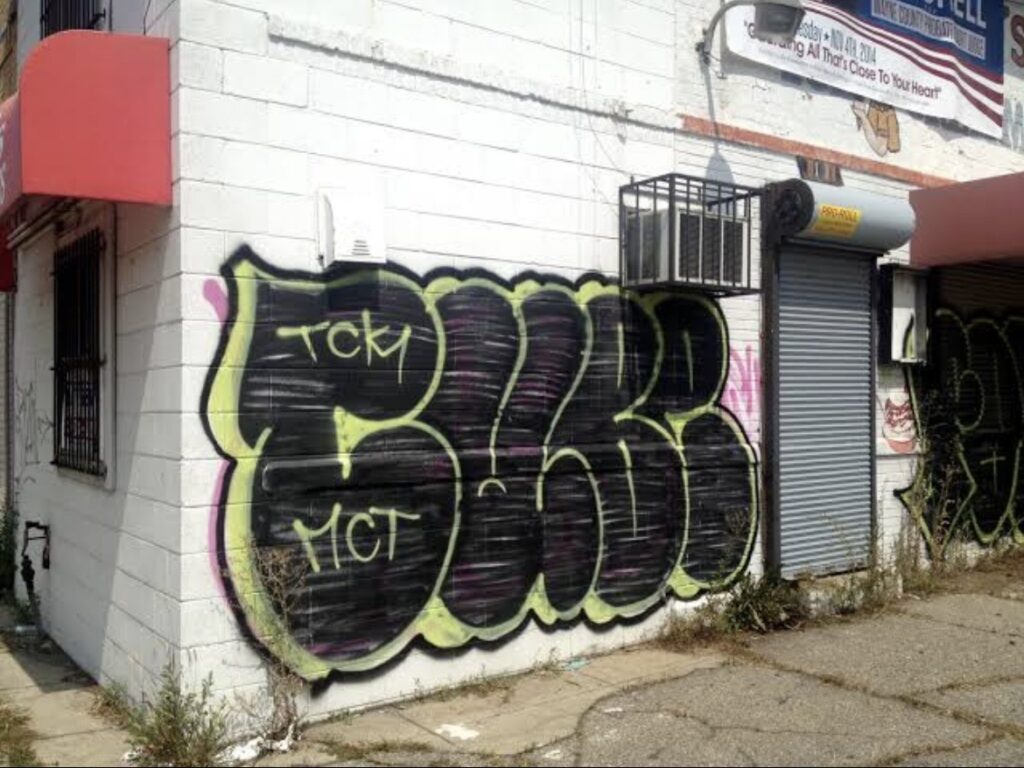
Detroit has a long and well-documented history of graffiti, tagging crews, and localized street cliques that operate in a gray area between neighborhood identity, loose social alliances, and more structured gang formations. From murals and handstyles to recurring neighborhood tags, these groups have shaped both the cultural and physical landscape of the city. This page presents an overview of notable tagger crews, individual writers, and street groups, drawing on information from local media, law-enforcement summaries, community reporting, and longstanding neighborhood narratives.
For definitions of terminology related to activity, conduct, demographics, gang-related terms, identifiers, and classifications used on this page, refer to the site glossary.
For definitions of terminology related to activity, conduct, demographics, gang-related terms, identifiers, and classifications used on this page, refer to the site glossary.
Overview:
Detroit’s tagging culture expanded significantly in the years following the city’s 2013 municipal bankruptcy. The surge in vacant and abandoned structures attracted both local and out-of-state graffiti writers, contributing to rapid growth in tagging activity, territorial disputes among crews, and a series of citywide enforcement efforts. In response, Detroit adopted a more stringent approach, including the creation of a dedicated graffiti task force aimed at reducing blight and documenting prolific tagging groups.
Under current city ordinances, property owners may face fines when unauthorized graffiti is not removed, with penalties beginning around $130 for a first citation, alongside additional removal-related costs that vary based on the size, location, and nature of the markings. The city also acknowledges that many property owners commission murals or stylistic artwork—some of which incorporate elements associated with graffiti culture—but requires formal authorization for such pieces to avoid penalties.
Tagger crews in Detroit are generally defined by their shared street identity and artistic output. While some members of these groups may occasionally be associated with criminal activity, tagging crews are primarily oriented around graffiti and related subcultural practices rather than the structured operations of traditional gangs. Established street organizations in Detroit—such as Blood-, Crip-, Gangster Disciple-, or Vice Lord–identified groups—may use graffiti for territorial marking, but they do not function as tagging crews. This distinction is central to the purpose of this page, which focuses specifically on the city’s graffiti-oriented groups and contributors.
Notable Crews
*In No Particular Order*
TCK Crew
• Historically identified by Detroit Police for widespread tagging across commercial and public structures.
• Multiple members were arrested in 2014 during coordinated anti-graffiti enforcement.
• Known for consistent presence on high-visibility corridors.
907 Crew
• Recognized for large-scale graffiti pieces and prominent placements.
• Often mentioned within Detroit’s larger graffiti movement after bankruptcy, with notable visibility along rail corridors and industrial zones.
NSF Crew
• Recognized for large block/bubble letter tags.
• Often mentioned within Detroit’s graffiti scence on social media
NFC Crew
• Recognized for tags city-wide.
• Known for consistent presence on the west side of Detroit.
For definitions of terminology related to activity, conduct, demographics, gang-related terms, identifiers, and classifications used on this page, refer to the site glossary.
Documented individual writers with recognizable presence across Detroit include:
*In No Particular Order*
PORAB, TURDL, ELMER, DONT, GASM, and PEAR.
Each tagger is noted for high-frequency marking, recurring styles, or widespread presence across multiple neighborhoods.
For definitions of terminology related to activity, conduct, demographics, gang-related terms, identifiers, and classifications used on this page, refer to the site glossary.
Detroit’s street groups vary widely: some are long-standing neighborhood cliques, some overlap with national affiliations, and others operate independently despite individual members claiming separate identities. Many of these groups are locally rooted and historically referenced through media, indictments, court records, or community accounts.
*In No Particular Order*
For definitions of terminology related to activity, conduct, demographics, gang-related terms, identifiers, and classifications used on this page, refer to the site glossary.
• Based in the Butler neighborhood (48234).
• Members may individually identify with Piru or Gangster Disciple affiliations, though the clique’s identity remains independent.
• Rivalries: local Crip sets, Hanna Street Bloods, 82 HeadBanger Bloods, and the 9000 GlockBoyz.
• Alliances: BBKRB30, with territory overlap.
For definitions of terminology related to activity, conduct, demographics, gang-related terms, identifiers, and classifications used on this page, refer to the site glossary.
• Three recognized neighborhood cliques operating around E. Seven Mile and Dequindre in the Hawthorne Park area.
• Names: Chase The Money Over Everything (CTMOE), Stomp Out Kings (SOK), and YRS.
• Function as longstanding Eastside sets with fluctuating membership and alliances.
For definitions of terminology related to activity, conduct, demographics, gang-related terms, identifiers, and classifications used on this page, refer to the site glossary.
• Once part of the 6 Minutes alliance with TNO/826 before a long-term split.
• Later aligned with BandGang (formerly MPR JackBoyz) and ShredGang, forming the BGSG association among younger members.
• Many members are older and/or incarcerated; active period peaked in the late 2000s and early 2010s.
• TTO and TNO/826 have maintained a documented 14-year rivalry that influenced broader Detroit street politics.
For definitions of terminology related to activity, conduct, demographics, gang-related terms, identifiers, and classifications used on this page, refer to the site glossary.
• Originated from the Darkside/Choppawood area around Dexter Ave, Joy Rd, and Collingwood.
• Founders included Dex Osama and Big Choppa.
• Mixed affiliations (Bloods/Vice Lords individuals), but operate primarily as an independent Dexter-area clique.
• Historical conflicts: BandGang/ShredGang, 9000GlockBoyz, TTO/886.
• Alliances: TMCNE/862, TNO/826, CashGang.
• Activity declined after Dex Osama’s death, with members dispersing.
For definitions of terminology related to activity, conduct, demographics, gang-related terms, identifiers, and classifications used on this page, refer to the site glossary.
• Older set based around Joy Rd & Linwood.
• Once allied with TNO/826.
• Reported activity has diminished significantly in recent years.
For definitions of terminology related to activity, conduct, demographics, gang-related terms, identifiers, and classifications used on this page, refer to the site glossary.
• Located in the Puritan area; historically linked to YBI (Young Boys Incorporated).
• Associated figures include D12 rapper Proof.
• Possibly defunct, though younger members align with RBI (RichBoyz Inc.).
• Rivalries: TSN, 22 Bandcrew.
• Neutral relations with 72 Pirus, with limited territorial overlap.
For definitions of terminology related to activity, conduct, demographics, gang-related terms, identifiers, and classifications used on this page, refer to the site glossary.
• Based near DLA on Dexter & Waverly.
• Cliqued up with TNO/826.
• Some members also affiliate with 22 BandCrew/Franchise.
Notes & Verification Status
Information is compiled from public records, community reports, and law enforcement sources.
Use of this page is for informational and historical purposes; it is not legal documentation.
Sources:
*Sources are listed in no particular order. Numerical placement does not indicate priority, authority, or primary-source status.*
- 1. Grokipedia 2026, Graffiti Crews and Street Groups in Detroit page
- 2. 2014 MLive Article, Detroit police arrest five vandalism suspects of ‘TCK’ graffiti group
- 3. 2017Detroit Metro Times Article, Inside Detroit’s merciless graffiti crackdown; Three years in, Mayor Mike Duggan’s war on graffiti has yielded more than 50 arrests and $1.2 million in fines
- 4. 2016 Vice Article, The Cleanup of Detroit Has Erased Graffiti History
- 5. 2022 City Of Detroit, Operation Compliance / Property Owner Guideline
- 6. City Ordinance, Questions and Answers on Detroit’s Graffiti Removal Efforts
- 7. 2019 Clck On Detroit Local 4 WDIV, Detroit marks removal of 100,000th illegal graffiti tag in city
- 8. 2025 Detroit Hybrid gangs Mini-documentary, Detroit’s Most Dangerous Hybrid Gangs: Crips, Bloods & Gangster Disciples Unite
- 9. Alamy Stock Photos 1997-2025, “Detroit Graffiti,” 1,200+ photos with EXIF data and detailed titles/captions used for identification and location context
- 10. “Tag” definition, GangEnforcement.com
- 11. Gang Terminology, GangEnforcement.com
- 12. Street Gangs, GangEnforcement.com
- 13. U.S. Department of Justice OJJDP, Hybrid and Other Modern Gangs
- 14. U.S. OJP, Hybrid and Other Modern Gangs