For definitions of criminal activities, and classifications used on this page, refer to the site glossary.
*In No Particular Order*
For definitions of terminology related to activity, conduct, demographics, gang-related terms, identifiers, and classifications used on this page, refer to the site glossary.
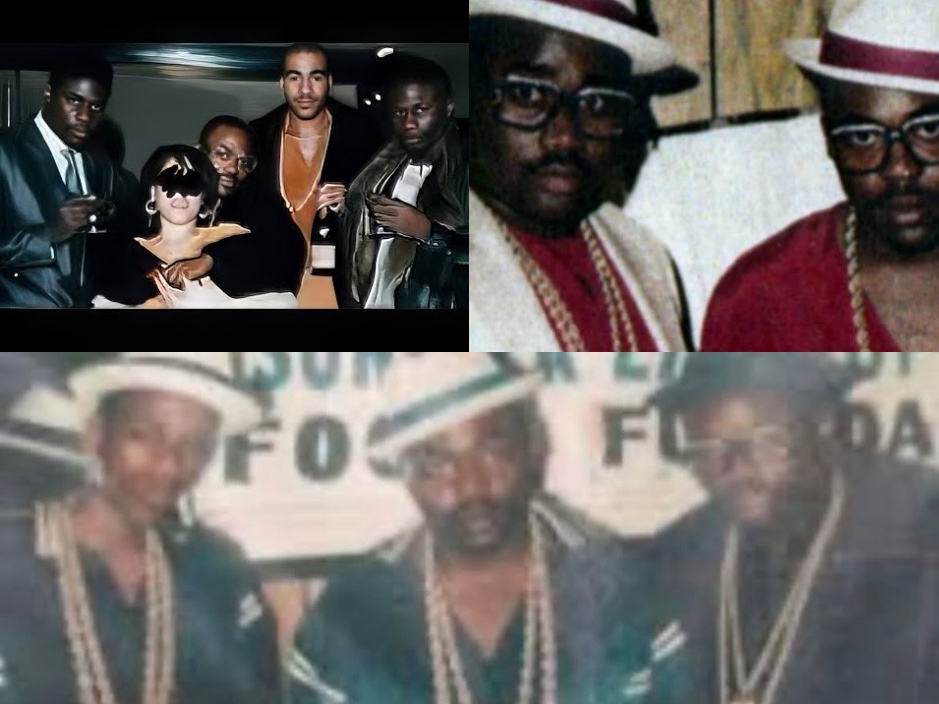
The Best Friends Gang—founded by brothers Ezra “Wizard,” Gregory “Ghost,” Reginald “Rockin Reg,” and Terrance “Boogaloo” Brown—emerged on Detroit’s east side as a street-oriented group involved in contract-killing before expanding into a major cocaine criminal enterprise. Initially working enforcement for Richard “Maserati Rick” Carter and Demetrius Holloway, the Browns eventually formed their own drug enterprise after gaining access to a Colombian supplier.
By 1986, the criminal enterprise had grown to 25–50 members and developed a reputation for discipline, secrecy, and high lethality. They controlled territory along Van Dyke and Harper and later pushed into rival zones across the east side. At their height, the Best Friends reportedly moved 100 kilograms of cocaine per week and expanded their network into Flint, Lansing, Grand Rapids, and parts of Ohio and Kentucky via the I-75 corridor.
A federal crackdown in the early 1990s—linked to murders, weapons offenses, and trafficking—ended the organization, culminating in a 1992 indictment of 29 members on 56 counts.
For definitions of terminology related to activity, conduct, demographics, gang-related terms, identifiers, and classifications used on this page, refer to the site glossary.
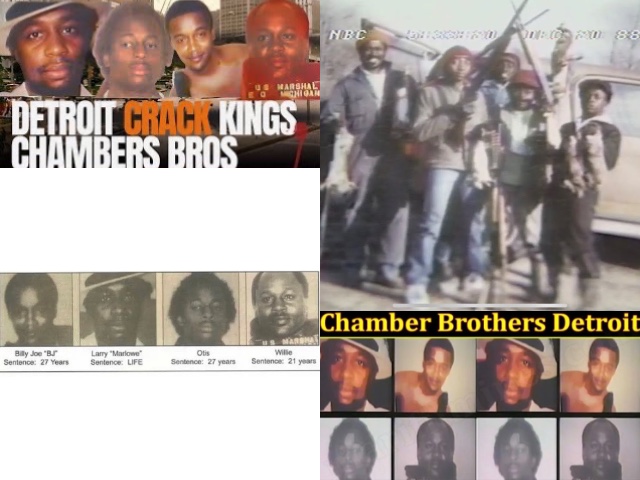
The Chambers Brothers—B.J., Larry, Willie, and Otis—operated one of Detroit’s most extensive crack cocaine criminal enterprises in the 1980s. Known for managing hundreds of crack houses and amassing large sums of cash, their criminal enterprise became nationally recognized after law enforcement obtained videotapes of them counting money and displaying wealth.
They controlled the Broadmoor apartment complex on E. Grand Blvd, later mirrored as “The Carter” in the film New Jack City. Their enterprise employed a large workforce and became an archetype of the crack-era drug structure. The group’s downfall arrived through extensive federal investigations, though their influence persisted in literature and popular culture.
For definitions of terminology related to activity, conduct, demographics, gang-related terms, identifiers, and classifications used on this page, refer to the site glossary.
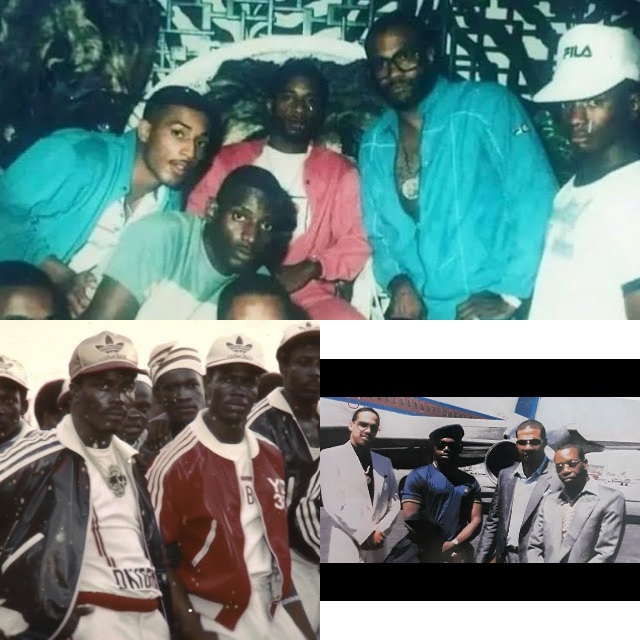
Young Boys Incorporated was a dominant criminal enterprise that specialized in the trafficking of heroin and crack cocaine. The enterprise was founded near Dexter and Davison in the late 1970s. Formed by youth gang members including Bone Man, Wonderful Wayne, Nut, and Choicey Chuck, YBI expanded into a highly organized criminal enterprise. At its height, YBI reportedly controlled 80% of Detroit’s heroin market, generating roughly $300,000 per day.
The enterprise maintained an enforcement arm known as the A-Team and became recognizable for its specific fashion and branding. Splits within YBI created factions led by Dwayne Davis, Raymond Peoples, and Butch Jones, resulting in internal conflict and homicides. Major federal indictments in 1982 and shifting drug markets (from heroin to crack) ultimately led to the group’s decline.
For definitions of terminology related to activity, conduct, demographics, gang-related terms, identifiers, and classifications used on this page, refer to the site glossary.
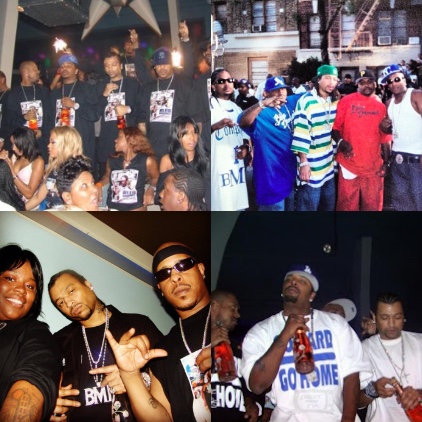
Founded by Demetrius “Big Meech” Flenory and Terry “Southwest T” Flenory, BMF was a criminal enterprise that originated in Southwest Detroit in the mid-1980s before expanding nationally. With operations in more than a dozen states—including hubs in Atlanta and Los Angeles—the organization grew into a large-scale cocaine distribution and money-laundering network with over 500 associates.
Internal disputes over lifestyle and exposure contributed to the brothers’ eventual separation. Federal wiretaps, surveillance, and synchronized raids in the 2000s dismantled the organization. BMF maintained ties to Detroit’s street scene and Atlanta’s rap industry before its collapse, with remnants later appearing in groups like Famgoon/Famerica.
For definitions of terminology related to activity, conduct, demographics, gang-related terms, identifiers, and classifications used on this page, refer to the site glossary.
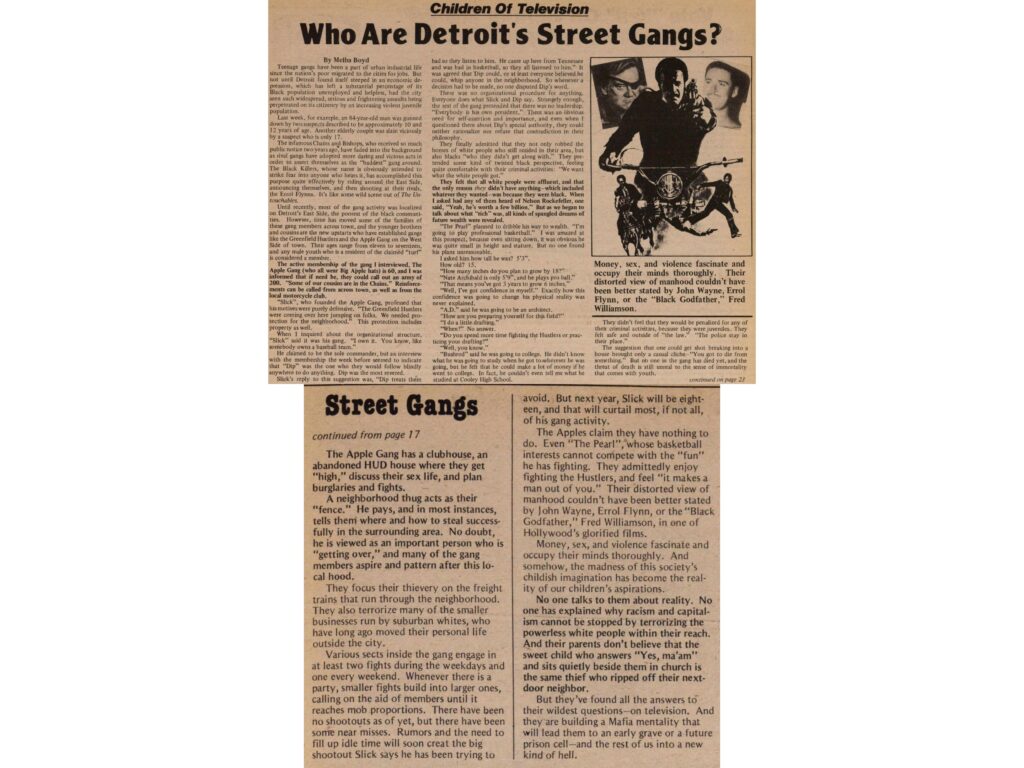
The Errol Flynns were a highly influential 1970s Detroit criminal street gang based along Kercheval between Mt. Elliott and Conner. Known for their flashy style and recognizable hand signs, the group became one of the city’s most prominent street organizations, controlling territory and engaging in robbery, extortion, and heroin trafficking.
Their displays of coordinated hand gestures and dances functioned as territorial markers at parties and neighborhood gatherings. The gang reached an estimated 400 members at its peak but declined in the 1980s due to major prosecutions and the shift toward crack cocaine markets. The Flynns significantly influenced later Detroit sets, including the Dexter Boys, FMK, Coney Oneys, 7 Mile Killers, and the Chene Gang.
For definitions of terminology related to activity, conduct, demographics, gang-related terms, identifiers, and classifications used on this page, refer to the site glossary.
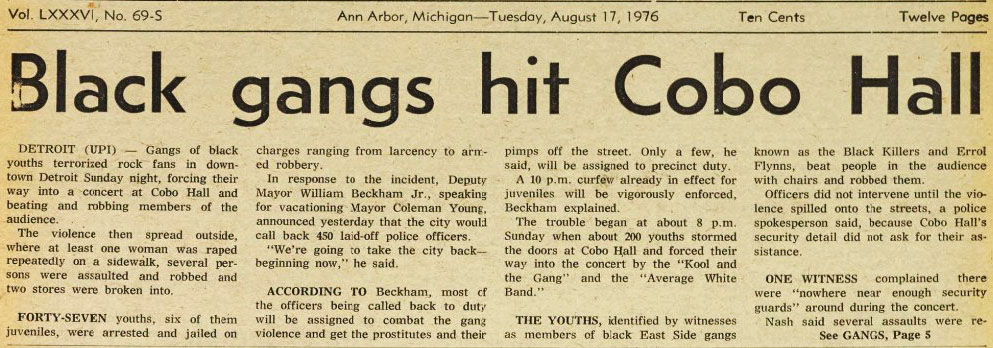
A criminal street gang known to be active in the 1970s, the Black Killers controlled turf bounded by Shoemaker (north), Mack (south), Conner (east), and Cadillac (west). Led by figures such as Sherm and Ced Tooks, Donnie King, and Jeff Dye, the gang became known for violent robberies, territorial enforcement, and internal discipline.
The gang’s conflicts with the Errol Flynns defined much of the era’s gang landscape. Numerous arrests and violent incidents—including multiple robberies and sexual assaults documented in a 1976 police report—characterized their operational peak. Future drug lord Johnny Curry was among their early members.
For definitions of terminology related to activity, conduct, demographics, gang-related terms, identifiers, and classifications used on this page, refer to the site glossary.
The Purple Gang, originally called the Sugar House Boys, was a Prohibition-era Jewish criminal street gang or enterprise based in Detroit’s lower east side (Little Jerusalem/Little Paris). Active in the 1910s–1930s, they controlled bootlegging, extortion, and racketeering operations. The group achieved significant influence during Prohibition but fractured in the 1930s due to internal warfare and federal pressure.
For definitions of terminology related to activity, conduct, demographics, gang-related terms, identifiers, and classifications used on this page, refer to the site glossary.
The Shakers, sometimes called the Shaker Gang or Shaker Stooges, were a major Detroit youth gang in the early 1950s with territory in the North End district. Known for large brawls—including a notable rumble with the Jokers at Berry School Playground—the group reportedly reached membership numbers near 700, including the “Shakerettes.”
The gang absorbed several smaller crews (Lover Boys, Kings’ Men, Seven Crowns, Chilli-Macs). Their most famous former member was singer Jackie Wilson.
For definitions of terminology related to activity, conduct, demographics, gang-related terms, identifiers, and classifications used on this page, refer to the site glossary.
A small Blood-aligned street clique formed in 1993 along Plymouth between Warwick and the Southfield Freeway. Their activity subsided through the late 1990s and they are now considered defunct.
For definitions of terminology related to activity, conduct, demographics, gang-related terms, identifiers, and classifications used on this page, refer to the site glossary.
A loosely organized street gang that self-identified as Blood-affiliated, and was reportedly established in 1992 along Plymouth between Southfield and Greenfield, the MadDawg Bloods were sometimes called the Black Counts due to close ties with the Latin Counts. The gang operated into the 1990s before dissolving.
For definitions of terminology related to activity, conduct, demographics, gang-related terms, identifiers, and classifications used on this page, refer to the site glossary.
A Latin Kings set—aligned with Chicago-lineage Kings—once active in Clark Park and Mexicantown. They maintained a rivalry with the Toledo Mafia Counts (TMC), which eventually overpowered and eliminated the Detroit set. No active presence remains.
For definitions of terminology related to activity, conduct, demographics, gang-related terms, identifiers, and classifications used on this page, refer to the site glossary.
A short-lived Mickey Cobras set near Chalmers & Outer Drive. Detroit never developed a stable MC presence, and this group faded quickly. Any modern claims are likely from older former members or unaffiliated individuals.
For definitions of terminology related to activity, conduct, demographics, gang-related terms, identifiers, and classifications used on this page, refer to the site glossary.
A small street clique composed largely of Bounty Hunna Bloods (BHB) near 8 Mile. Active around 2012–2013, they maintained alliances with YGB, LTC, and CTM and rivalries with Bandcrew, TSN, RTM, CMH, HoodRich, and WildLife. The set is now fully inactive.
For definitions of terminology related to activity, conduct, demographics, gang-related terms, identifiers, and classifications used on this page, refer to the site glossary.
A brief Rollin’ 60s Neighborhood Crip street clique presence near Joy Road & Southfield. Their lack of numbers prevented long-term activity, and the set dissolved.
For definitions of terminology related to activity, conduct, demographics, gang-related terms, identifiers, and classifications used on this page, refer to the site glossary.
The Delray neighborhood—once a multi-ethnic industrial community—declined sharply due to pollution, plant closures, and mass demolitions tied to the Gordie Howe Bridge project. The Delray Boys, a small local street clique operating during the area’s later years, disappeared as the neighborhood itself was largely erased.
For definitions of terminology related to activity, conduct, demographics, gang-related terms, identifiers, and classifications used on this page, refer to the site glossary.
Based on Bayside Street in Oakwood, this Latin Counts set feuded with Sur 13 and the Gangster Disciples. Industrial expansion, heavy demolition, and Marathon Petroleum’s buyouts of Oakwood Heights eliminated the neighborhood and the gang’s presence with it.
For definitions of terminology related to activity, conduct, demographics, gang-related terms, identifiers, and classifications used on this page, refer to the site glossary.
A Cass Corridor-based criminal street gang believed to be defunct. Their territory sat near major institutions like Cass Tech, prompting law-enforcement pressure. By the late 2010s, the area shifted toward crews like 2030 or TMO. Federal efforts to clean up the corridor ended A1’s presence.
For definitions of terminology related to activity, conduct, demographics, gang-related terms, identifiers, and classifications used on this page, refer to the site glossary.
A Southwest Detroit criminal street gang not formally aligned with any national gangs, the gang had intermittent rivalries with local Latin Counts and Gangster Disciples. They were also known by names such as ‘CFP,’ ‘2400,’ and ‘4400.’ The gang was primarily active in the early to mid-2000s. One alleged member was of the gang named Efraim Garcia was charged with multiple racketeering related crimes. Present-day activity is disputed: some accounts suggest limited involvement by a small number of older members, while others describe the gang as largely inactive. Available street-level observations generally support the latter.
Notes & Verification Status
Information is compiled from public records, community reports, and law enforcement sources.
Use of this page is for informational and historical purposes; it is not legal documentation.
Sources:
*Sources are listed in no particular order. Numerical placement does not indicate priority, authority, or primary-source status.*
- 1. United States Court of Appeals,Sixth Circuit., UNITED STATES v. ANDERSON (1996)
- 2. 1987 Detroit Free Press Archived Article, YBI INDICTMENT CHARGES 26
- 3. United States v. Garcia, 68 F. Supp. 2d 802 (E.D. Mich. 1999), Cash Flow Posse case
- 4. UofM History Labs Article, Policing in Southwest Detroit; Brief History of Southwest, Detroit (SW)
- 5. MOBFAX Youtube-Mini-documentary, Detroit: Crack Inc – The Chambers Brothers (1988)
- 6. 2018 Click On Detroit Local 4 WDIV, 1975 Detroit Crime Special
- 7. 1976 News Article Archive, Cop Gang vs. Street Gangs
- 8. UofM History Labs Article, Young Boys Incorporated
- 9. 2018 Click On Detroit, Detroit police, feds work to rid area near Cass Tech of ‘A1 Killers’ gang activity
- 10. Detroit Historical Society, PURPLE GANG
- 11. Wikipedia Article, Chambers Brothers (gang)
- 12. Wikipedia Article, Purple Gang
- 13. Wikipedia Article, Young Boys Inc.
- 14. Wikipedia Article, Errol Flynns
- 15. “Tag” definition, GangEnforcement.com
- 16. Gang Terminology, GangEnforcement.com
- 17. Street Gangs, GangEnforcement.com