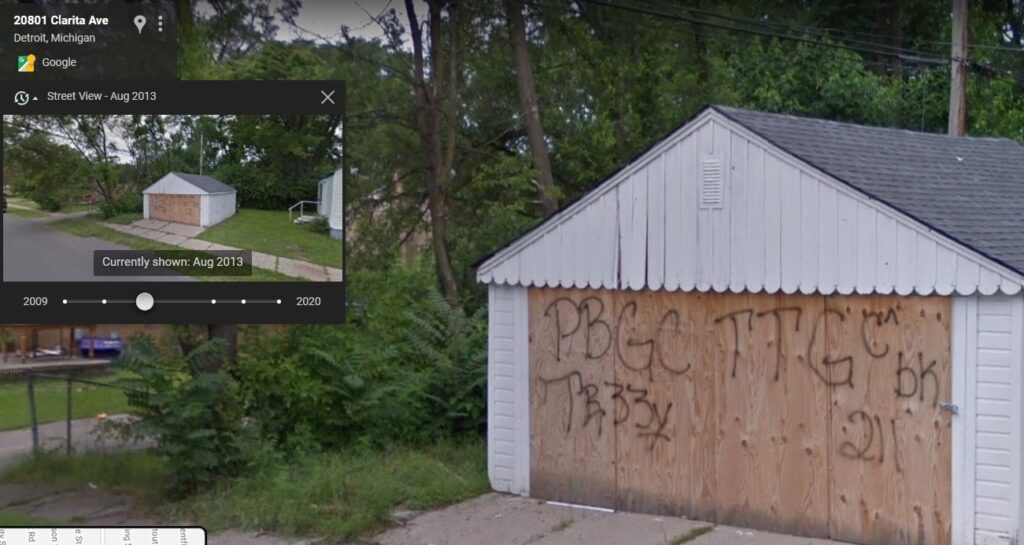
The 7 Mile Playboy Gangster Crips, often called 7M PBGC or the Playboys, are documented as a predominantly African American, Crip-affiliated criminal street gang based primarily along West Seven Mile Road in northwest Detroit. This page outlines their history, aliases, territory, affiliations, activities, rivals, and local cultural influence.
For definitions of terminology related to activity, conduct, demographics, gang-related terms, identifiers, and classifications used on this page, refer to the site glossary.
For definitions of terminology related to activity, conduct, demographics, gang-related terms, identifiers, and classifications used on this page, refer to the site glossary.
*In No Particular Order*
- PBGC
- 33rd Gangsters
- Trey-Trey Gang
- Rabbit Gang
- SavGang
For definitions of terminology related to activity, conduct, demographics, gang-related terms, identifiers, and classifications used on this page, refer to the site glossary.
*In No Particular Order*
- Northwest Detroit – 48219 ZIP code
- Holcomb Community neighborhood
- W. Seven Mile & Evergreen
- W. Seven Mile & Lahser
- Documented spillover into Redford and Southfield
For definitions of terminology related to activity, conduct, demographics, gang-related terms, identifiers, and classifications used on this page, refer to the site glossary.
No Particular Order*
For definitions of terminology related to activity, conduct, demographics, gang-related terms, identifiers, and classifications used on this page, refer to the site glossary.
Members reportedly wear blue bandannas (Navy Blue), and mark territory with graffiti tags such as ‘PBGC’ (Playboy Gangsta Crips) or ‘33rd Gangster’ (referencing their ‘trays/treys,’ or 3X/Movin Gang affiliations). Associated colors in graffiti reportedly includes blue and black. In conversation, music, and social media, the group’s territory was often referred to as ‘Gangsta City.’ Reported hand-signs included gestures resembling rabbit ears (symbolic of ‘Playboys’), the number 7 (W. Seven Mile Road), and the letters G (Gangsta/Gangster) and C (Crip/Crips). Accounts also describe an internal hierarchy in which individuals were referred to as Original Gangster, Original Baby Gangster, Young Baby Gangster, Baby Gangster, or Tiny Gangster.
For definitions of terminology related to activity, conduct, demographics, gang-related terms, identifiers, and classifications used on this page, refer to the site glossary.
*In No Particular Order*
- Racketeering
- Narcotics trafficking
- Firearms trafficking
- Burglary
- Arson
- Armed robbery
- Murder
- Street-level disputes
- Territorial graffiti
- Reported disruptions of lawful or public meetings
- Transit fare evasion
- Loitering
- Public intoxication
- Intimiadtion
- Boosting
For definitions of terminology related to activity, conduct, demographics, gang-related terms, identifiers, and classifications used on this page, refer to the site glossary.
- Rollin’ 60s (primarily 7M R$C)
- Local Blood sets, including 6 Mile Bounty Hunna Watts Bloods
- Independent street crews in overlapping areas
For definitions of terminology related to activity, conduct, demographics, gang-related terms, identifiers, and classifications used on this page, refer to the site glossary.
The 7 Mile Playboy Gangster Crips (7M PBGC) emerged in northwest Detroit in the early 2000s as a locally organized set affiliated with the Gangster Crips (3X/Movin’). The group has been cited in municipal and federal reports for organized criminal activity, most notably the 2019 federal RICO case that resulted in sixteen convictions for drug distribution and burglary-related charges.
The set historically maintained a formal internal hierarchy, with ranks such as Original Gangster, Original Baby Gangster, Young Baby Gangster, Baby Gangster, and Tiny Gangster. Their visibility in parts of the Seven Mile corridor—marked by territorial activity and recurring graffiti—contributed to their reputation as one of the more prominent Gangster Crip–aligned groups in Detroit during the 2000s and 2010s.
Law-enforcement and research accounts describe the group’s use of vacant structures, fixed hangouts, and social media as part of their operational pattern. These methods—such as defined territory, decentralized stash locations, and coordinated activity schedules—later appeared among other west-side 3X/Movin’-aligned sets, influencing the organizational style of many subsequent Detroit cliques.
Following the RICO investigation, the set’s public presence declined sharply. Authorities have referred to the group as “dismantled,” though occasional graffiti and scattered community references indicate limited residual activity in areas historically linked to the organization. Their long-term feud with the 7 Mile Rollin 60s Crips remains a significant component of Detroit’s Crip-affiliated history.
In retrospective accounts, the 7M PBGC are often cited as a major early influence on Detroit’s Crip identity—second in visibility and reach only to the Rollin 60s during their period of activity. Their prominence contributed to heightened federal scrutiny in the 2010s as smaller cliques adopted aspects of either Gangster Crip (3X/Movin Gang) or Rollin Neighborhood Crip (2X/Rollin) identity.
Detroit’s Crip landscape is highly localized. While national distinctions such as 2X (Neighborhood Crips/Rollin) versus 3X (Gangster Crips/Movin Gang) inform identity, they do not consistently define alliances or conflicts. Some modern groups employ hybrid identities, such as ReaperGang/1229, which incorporates elements associated with both Shotgun Crips and the Rollin 60s. Overall, Detroit’s Crip-aligned dynamics are shaped more by neighborhood conditions than by strict national frameworks.
For definitions of terminology related to activity, conduct, demographics, gang-related terms, identifiers, and classifications used on this page, refer to the site glossary.
The 7M PBGC presence extends into Detroit’s underground rap scene and local street culture. Members frequently use music, social media, and graffiti to broadcast territorial pride, alliance with the 3X Movin’ Crips umbrella, and connections to “Gangsta City.”
Notes & Verification Status
Information is compiled from public records, community reports, and law enforcement sources.
Use of this page is for informational and historical purposes; it is not legal documentation.
Sources:
*Sources are listed in no particular order. Numerical placement does not indicate priority, authority, or primary-source status.*
- 1. Grokipedia 2026, 7 Mile Playboy Gangster Crips page
- 2. DOJ Press Release 2019, 16 Members of a Violent Gang from Detroit’s Westside Have Been Convicted for Their Roles in a Racketeering Conspiracy
- 3. Justia 2020, United States v. Tisdale, No. 19-1901 (6th Cir. 2020)
- 4. Click On Detroit Local 4 WDIV 2019, Inside the takedown of the ‘Playboy Gangster Crips’
- 5. Click On Detroit Local 4 WDIV 2018, Feds bust ‘Playboy Gangster Crips” gang
- 6. Detroit Free Press 2017, Busted on Facebook? Feds say Playboy Gangster Crips crew sold drugs, AK-47 on social media
- 7. 2025 Detroit Crips Mini-documentary, Most Dangerous Crip Gangs in Detroit: The Real Story of Power, Bloodshed & Survival
- 8. 2025 Detroit Bloods Mini-documentary, Most Dangerous Blood Gangs in Detroit EXPOSED: 55 Seven Mile Bloods, 82 Headbanger Bloods & More!
- 9. Alamy Stock Photos 2015-2025, “Detroit Crips Graffiti,” 330+ photos with EXIF data and detailed titles/captions used for identification and location context
- 10. Gang Terminology, GangEnforcement.com
- 11. Street Gangs, GangEnforcement.com
- 12. National Gang Center (NGC), Michigan Gang-Related Legislation By State